A different way into the solar system: close up, absorbing, and full of things you didn’t know. Everything you ever wanted to know in plain language, plus a pile of details that will catch you off guard.
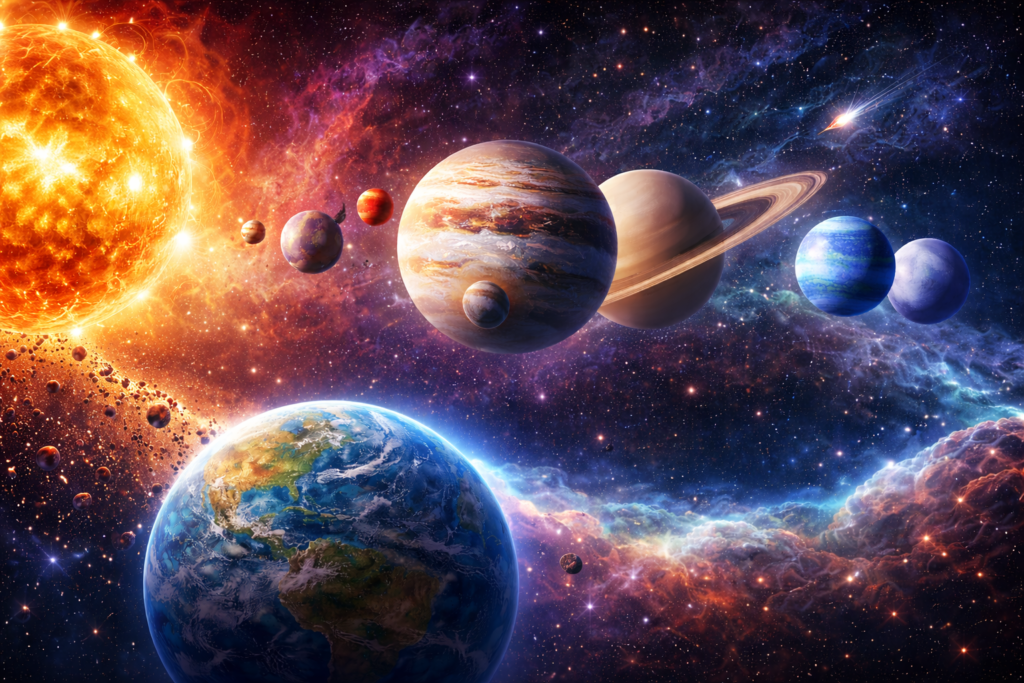
Whenever I think about the solar system, my brain still serves up those grade-school posters with the planets lined up in a neat row, like they’re waiting their turn for something. The real thing is far better. The solar system is a stage in constant motion, where everything spins, shifts, evolves, and surprises you more often than you’d expect. I like picturing it as a big, slightly eccentric family whose members have almost nothing in common except the figure they all orbit: the Sun.
Exploring it is like opening a box of surprises. You start with something that seems simple, the Moon, say, and three hours later you’re reading about storms on Neptune or moons with unpronounceable names hiding seas of methane. The wildest part is that we’re barely getting started. There’s so much left to find that it makes you a little dizzy, and it also makes you want to keep looking up.
The heart of it all, the Sun
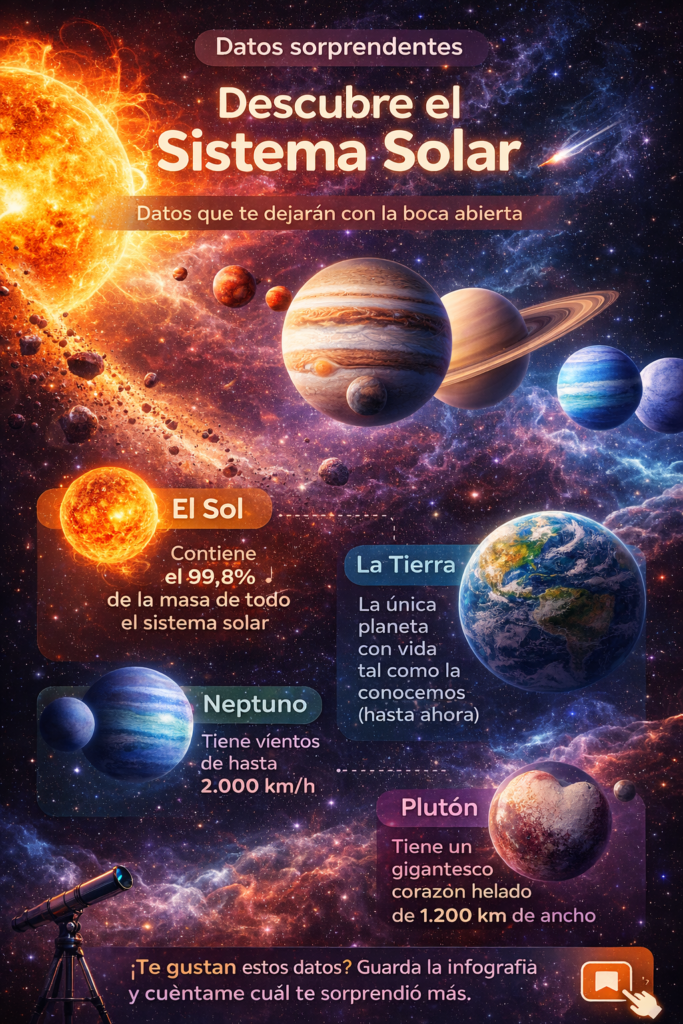
The Sun is the whole ballgame. It isn’t just the light coming through the window in the morning or the reason you put on sunscreen in July. It’s a star, an enormous ball of glowing gas kept running by one remarkable process: nuclear fusion. What goes on in the core reads like magic and happens to be physics. Under staggering temperature and pressure, hydrogen atoms fuse into helium and release a colossal amount of energy that works its way out to the surface and from there into the entire solar system.
That energy is what makes life on Earth possible, what gives us seasons, what drives the climate, and what lets you put panels on your roof. Nothing we know would exist without it. Its gravity is also strong enough to hold every planet in orbit around it, each on its own track, like pieces of a choreography that’s been running for billions of years.
The Sun is about 4.6 billion years old and should keep shining for another 5 billion. That’s oddly reassuring. It’s big enough to swallow more than a million Earths, and every single second it converts roughly 600 million tons of hydrogen into helium. Sit with that number for a moment.
One detail I’ve always loved: sunlight takes about eight minutes and twenty seconds to get here. The light landing on your face right now left the Sun’s surface a little over eight minutes ago. Not a bad piece of time travel, even if it’s only visual.
The inner planets, our rocky neighbors
The inner planets are the four closest to the Sun: Mercury, Venus, Earth, and Mars. They share one thing, which is that they’re built mostly of rock and metal, unlike the gas giants waiting for us farther out. Sitting close to the Sun with solid ground underfoot doesn’t make them alike, though. Each one has its own personality.
Mercury
Mercury is small, fast, and hard to catch with the naked eye because it never strays far from the Sun in our sky. You can spot it at dawn or dusk, but you have to know exactly when and where to look. It has no real atmosphere, which lets surface temperatures swing brutally between day and night: up around 800°F (430°C) in daylight, down near -290°F (-180°C) after dark.
Mercury turns on its axis once every 59 Earth days. Because of the way its spin and its orbit are locked together, though, a full solar day there, one sunrise to the next, runs about 176 Earth days. Standing on the surface, you’d watch the Sun crawl.
Venus
Venus is a beauty from where we’re standing. It’s one of the brightest objects in the sky and people mistake it for a star constantly. What it’s hiding under that thick atmosphere is another matter entirely. Surface temperatures run past 860°F (465°C), the air is mostly carbon dioxide, and the clouds are sulfuric acid. All of it adds up to a greenhouse effect so severe that Venus is the hottest planet in the solar system, hotter than Mercury even though it sits farther out.
Venus also spins backward compared with most of the planets, and it spins so slowly that a Venusian day outlasts its year. Hard to picture, but there it is, turning at its own pace under an atmosphere nothing gets through.
Earth
Earth is a fluke of the best kind. It’s the only place in the universe we know of with life on it, and that isn’t luck alone. Our distance from the Sun is right for liquid water. We have an atmosphere that regulates temperature, blocks dangerous radiation, and happens to be breathable. We have a magnetic field that deflects the solar wind. On top of all that, we have a Moon big enough to stabilize our tilt and run the tides.
From space, Earth reads as a blue and white sphere, obviously alive. I don’t think we appreciate our luck often enough. Surrounded by hostile worlds, we happen to live on the one exceptional corner.
Mars
Mars has probably fired up more imaginations than any other planet. It goes by the red planet thanks to the iron oxide coating its surface, which is essentially rust. It has seasons like ours, a day almost exactly as long as ours, polar caps, and solid evidence that liquid water once ran there in quantity. Ice is still around today, at the poles and buried under the surface in places.
It’s home to Olympus Mons, the tallest volcano in the solar system at roughly 13 miles high, and to Valles Marineris, a canyon system long enough to stretch most of the way across the continental US. Mars may well end up being somewhere we go. Missions already underway and plans to send people in the coming decades make it a real target rather than a fantasy.
The outer giants, worlds of gas and ice
Now we head out to the far side of the Sun’s territory. Out here are enormous planets with no solid surface to stand on, built mostly of gases or ices. Distant as they are, these planets play a decisive role in the balance of the whole system, and they’re genuine laboratories for extreme weather.
Jupiter
Jupiter is the largest planet in the solar system by a wide margin. You could fit every other planet inside it and still have room. Its presence is imposing. The atmosphere is dense and violent, striped with color bands that shift constantly, and marked by a Great Red Spot that’s really a storm which has been running for centuries. Its magnetic field is ferocious, and it has a faint ring system that almost nobody notices.
The moons are one of the best things about Jupiter. More than 90 are confirmed, and a few of them qualify as worlds in their own right. Ganymede is the largest moon in the solar system, bigger than Mercury. Europa hides an ocean beneath its icy shell that could conceivably support life. You could spend years on Jupiter and its moons alone.
Its massive gravity acts as a kind of shield for the rest of the planets, deflecting or capturing comets and asteroids that might otherwise become Earth’s problem. Calling Jupiter the solar system’s bodyguard isn’t much of a stretch.
Saturn
Saturn is famous for the rings, and deservedly. They’re spectacular, made of millions of chunks of ice and rock whipping around the planet. They look solid from a distance, yet they’re astonishingly thin compared with the size of the planet itself.
This gas giant also carries a huge collection of moons, more than 270 confirmed at last count, which recently pushed it past Jupiter for the title. One of them stands out: Titan. It’s the second-largest moon in the solar system and it has a dense atmosphere, which is genuinely rare for a moon. It also has lakes and rivers of liquid methane and ethane. It’s frigid, but it’s one of the most promising places to look for prebiotic chemistry, meaning conditions that might resemble the early Earth.
Saturn is also one of the most satisfying things to point a telescope at. Even a modest scope shows the rings clearly, and that never gets old.
Uranus
Uranus is odd from every angle. The first thing anyone notices is that it’s tipped completely over, rolling along its orbit instead of spinning upright. That extreme tilt produces seasons that last decades. Its blue-green color comes from methane in the atmosphere, which absorbs red light and reflects blue.
It has rings, far more subdued than Saturn’s, plus a set of barely explored moons. We know relatively little about it next to the other giants, and it could hold plenty of surprises. A dedicated Uranus mission sits near the top of a lot of scientists’ wish lists.
Neptune
Neptune is the farthest planet from the Sun. Its deep blue also traces back to methane, though it’s worth knowing that recent work suggests Uranus and Neptune are much closer in color than the classic images made them look. The dramatic difference we all grew up with owes a lot to image processing and to a haze layer sitting over Uranus.
It’s an extremely active place, with winds clocked around 1,200 miles per hour (2,000 km/h), the fastest known on any planet.
It has one very strange moon, Triton, which orbits backward relative to Neptune’s rotation. That probably means Triton was captured by Neptune’s gravity rather than forming alongside it. It’s the kind of detail that makes the solar system so good. Scratch anywhere and a hidden story falls out.
Other bodies out there, beyond the planets
We tend to think of the solar system as the Sun plus eight planets, but there’s a much larger cast. Some members go completely unnoticed. Others have become media stars, either through the news or through sheer mystery.
Pluto and the dwarf planets
Pluto was the ninth planet for a long stretch. Then, in 2006, it got reclassified as a dwarf planet. It remains one of the most beloved objects out there anyway. Its icy surface, its mountains of ice, and its thin atmosphere make it a genuinely special place. It also has an enormous moon, Charon, with which it forms a binary system. The two orbit each other like inseparable partners.
Beyond Pluto there are other dwarf planets: Eris, Haumea, Makemake, and Ceres. That last one sits in the asteroid belt between Mars and Jupiter, and although it’s far smaller than any planet, it’s spherical and comes with interesting features, including possible reservoirs of water under the surface.
What all these small worlds share is that they orbit the Sun and carry enough mass to pull themselves into a sphere, without having cleared their orbital neighborhood of other objects. That’s what separates them from the major planets. Each one still has a fascinating history and a part to play in the system’s dynamics.
Asteroids
Asteroids are rocky bodies orbiting the Sun. Most of them live in the asteroid belt, the region between Mars and Jupiter. Some are gigantic, like Vesta and Pallas, and others are smaller than a house. Plenty have stable orbits, though a few swing uncomfortably close to Earth from time to time. That’s why there are programs tracking their paths, to head off a possible impact.
Asteroids are the fossils of the solar system. They haven’t changed much since they formed, so studying them offers clues about how the planets came together. Some could even serve as a source of minerals down the road.
Comets
Comets are dirty snowballs made of ice, dust, and rock. When one swings near the Sun, the heat drives off gas and particles that form the glowing tail we recognize instantly. Halley’s Comet is among the best known, visible from Earth roughly every 76 years. Watching a comet cross the sky is one of those experiences that sticks with you.
Some comets travel on wildly elliptical orbits that carry them out to the edge of the solar system before bringing them back centuries later. Others, like 67P, the one the Rosetta probe studied up close, run on steadier, more predictable paths. What they all share is that they’re witnesses. They carry primordial material from back when the solar system was nothing but a disk of gas and dust.
The Kuiper Belt and the Oort Cloud
Past Neptune lies the Kuiper Belt, a region packed with icy objects, dwarf planets among them. Pluto is thought to have formed here, and thousands more bodies are presumably waiting to be found. The Kuiper Belt works like an outer ring around the solar system, and we’ve barely scratched it.
Farther still, out at the true edge, sits the Oort Cloud, a hypothetical shell that may hold billions of comets. It’s so remote we’ve never observed it directly, though it’s believed to be the source of many long-period comets. It marks the outer limit of the Sun’s influence, the last place its gravity still holds anything together.
How to see the planets from your own backyard
Observing planets can feel complicated at first, but with a few pointers and a little patience you can see far more than you’d expect, even without a telescope. All you need is to know when to look, where to look, and what to reasonably expect.
Pick a good spot
Find somewhere dark, away from city lights. A clear sky is essential. The less light pollution around you, the more stars and objects you’ll pick up. Rural areas, mountains, and beaches all tend to work well. It also helps to have an open horizon, free of buildings and tall trees.
Use a sky map app
Apps like Stellarium, SkyView, and Star Walk help you identify planets and constellations. Point your phone at the sky and it tells you what you’re looking at. They’re great for beginners and they hand you detailed information about what’s observable on any given night. You can even set reminders for when a planet is especially well placed.
Which planets you can see with the naked eye
Mercury, Venus, Mars, Jupiter, and Saturn are all visible without equipment at various points in the year. Venus is usually the brightest, showing up right before sunrise or shortly after sunset, which is how it earned the nicknames morning star and evening star. Mars has a reddish cast that’s easy to pick out. Jupiter and Saturn are bright and hold steady instead of twinkling like stars. Jupiter will even show you its moons through ordinary binoculars.
Mercury is the hardest of the bunch, since it hugs the Sun and only appears in narrow windows, right before dawn or right after dusk. If you’ve never caught it, make it a personal challenge. There’s something deeply satisfying about finding it the first time.
How to use binoculars
A decent pair of binoculars, 10×50 for instance, shows you real detail. Jupiter reveals its four largest moons lined up like tiny stars. Saturn appears as a slightly squashed sphere, and with practice you may start to separate out the rings. Mars and Venus show as small disks, clearly not stars. You can also pick out craters on the Moon with surprising definition.
Use a tripod, or brace the binoculars against something solid so the image holds still. On clear, moonless nights you’ll see dramatically more.
Be patient and let your eyes adjust
Once you’re somewhere dark, give your eyes time. They need 15 to 30 minutes to fully adapt. Stay off screens and away from white lights during that stretch. Use a red flashlight if you need to check something. Little by little you’ll watch the sky fill in with detail, almost like somebody is slowly turning up the brightness on the stars.
Take your time up there
Watching the sky isn’t only about planets. It’s an exercise in paying attention. Some nights you’ll see nothing remarkable. Other nights, without warning, a meteor streaks past, a satellite crosses overhead, or a planet lines up beside the Moon. Every night is different, and the more familiar the sky becomes, the more you start to catch.
Even without a telescope, you can start building a relationship with the sky. All it takes is curiosity and a few minutes of looking up.
Frequently asked questions about the solar system
How many planets are there really?
Eight planets are currently recognized in the solar system: Mercury, Venus, Earth, Mars, Jupiter, Saturn, Uranus, and Neptune. Pluto held the ninth spot for decades, until the International Astronomical Union reclassified it as a dwarf planet in 2006. Plenty of people still keep a soft spot for it. There are other recognized dwarf planets too, including Ceres, Eris, Makemake, and Haumea.
Why isn’t Pluto a planet like the others anymore?
To count as a planet, a body has to meet three conditions: orbit the Sun, carry enough mass to pull itself into a sphere, and clear its orbital neighborhood of other objects. Pluto meets the first two and fails the third, since it shares its orbit with other Kuiper Belt objects. That’s what got it reclassified as a dwarf planet. The decision caused a fair amount of uproar, though it reflects how our system of classifying the universe keeps improving.
Will we ever live on Mars?
A great deal of effort is pointed that way. Missions are underway to study the surface, the atmosphere, and the available resources. Living there won’t be simple. There’s no breathable oxygen, radiation is a serious problem, the cold is extreme, and food would have to be produced on site. With better technology and simulation work here on Earth, though, it’s plausible that we see the first human settlements on Mars within a few decades. Probably not a permanent colony at first, more like research bases.
Are there other solar systems like ours?
Yes. Thousands of exoplanets, meaning planets orbiting other stars, have been discovered over the past few decades. Many belong to systems with features similar to our own. Some hold several planets, others just one. There are giants, rocky worlds, planets with thick atmospheres and planets with none at all. A few even sit in their star’s habitable zone, which raises every kind of question about the possibility of life beyond Earth.
What happens when the Sun dies?
The Sun has a finite life. It’s in a stable stretch now, but in roughly five billion years it will start running out of fuel. It will swell into a red giant and most likely swallow Mercury, Venus, and possibly Earth. After that it will shed its outer layers, leaving behind a white dwarf, the hot dense core that cools off slowly over an enormous span of time. It won’t be a sudden explosion. It’ll be a slow, spectacular transformation, and there’s a great deal of time left before any of it matters.
One last thought before I go
The solar system is much more than a list of planets or a model built out of styrofoam balls. It’s a dynamic, living system in constant motion. It’s full of contrast, full of beauty, full of stories we haven’t finished telling. Every planet, every moon, every asteroid and comet offers a clue about how all of it came together and where we fit inside it.
Sometimes all it takes is stepping outside on a clear night and looking up. Catching Jupiter blazing away, noticing Saturn come out right after sunset, getting caught off guard by Venus burning on the horizon. Small moments, all of them, with something magical in there. They connect you to something larger.
I hope this piece sparked some curiosity, or made you look up with fresh eyes, or reminded you that even on one small blue planet, we’re part of something much bigger and far more interesting.
Tell me in the comments: did anything here surprise you? Have you ever spotted a planet with your own eyes? Would you like a month-by-month guide to observing the sky?
I’d love to keep the conversation going. Leave a question, share your experience, or just tell me which part of the solar system pulls at you most.
Thanks for reading this far.
Remember: looking up, even for a few minutes, is always worth it.