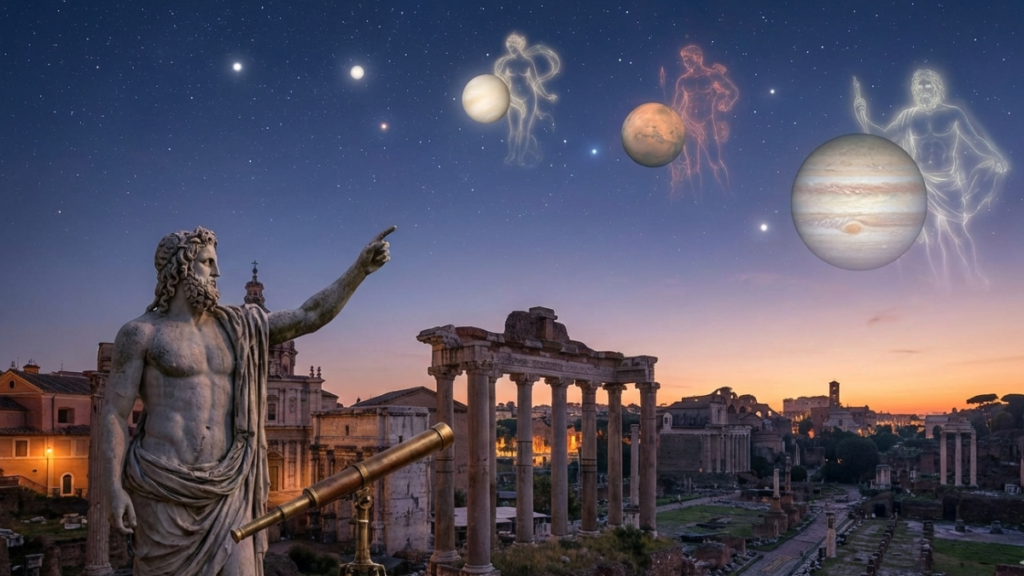
Ever wondered why Mars is the red planet, or who Venus actually was? Come along on an epic tour through where the planets got their names and the myths behind them. A full guide to the soul of the cosmos, the name of the planets.
Last night I stood outside staring at the sky, in that particular quiet you only get in the small hours, and something hit me. We look up, we pick out Venus outshining everything around it, or that faint rusty dot that’s Mars, and we say the names like they’re nothing. Have you ever stopped to think about the amount of history, drama, and sheer opera packed into each of those words?
Once I start pulling a thread like this I can’t stop. You know how I am. I love understanding why things are the way they are, and above all I love the magic the ancients saw in those points of light that moved differently from the stars. To them these weren’t rocks or balls of gas. They were living beings, powerful, with personalities big enough to steer human fate.
So let’s take a trip together. No spacecraft required, just some imagination and an appetite for celestial gossip. We’re going to dig into why we call the planets what we call them, which gods are hiding behind those orbits, and which legends survived thousands of years to reach us. Fair warning: there are betrayals, impossible loves, and a whole lot of cosmic energy ahead.
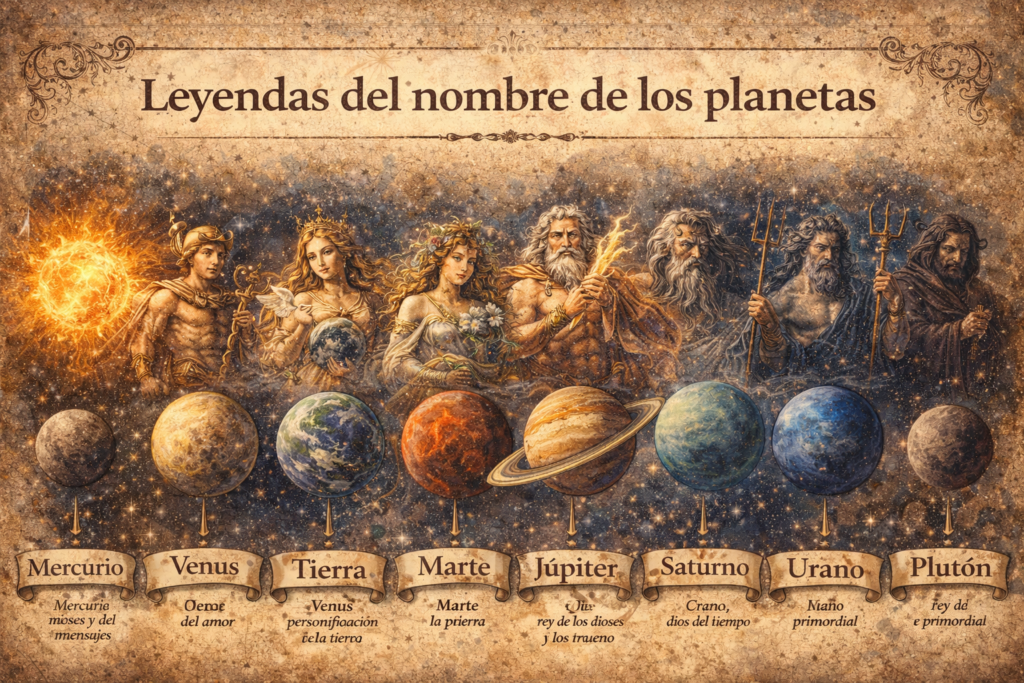
Where the planet names came from, a trip through history
First thing to know: the Greeks told most of these stories, yet the names we actually use are almost all Roman. Funny twist of fate, isn’t it?
The Romans were experts at absorbing other people’s cultures. They took the Greek pantheon, swapped out the cast names, and packaged it so effectively that their version is the one that made it down to us.
The planets visible to the naked eye, meaning Mercury, Venus, Mars, Jupiter, and Saturn, have carried names for as long as humans have been paying attention. The Babylonians already had them tracked, but it was the Greeks who gave them that mix of human and divine.
They called them the asteres planetai, which translates to wandering stars. I love that. While the fixed stars all moved as one obedient group, these rebels went their own way, tracing odd paths across the sky. If something moves like that up there, obviously it has to be a god.
Mercury, the tireless runner with wings on his feet
We’ll start with the one closest to the Sun. Mercury is a planet in a permanent hurry, and that isn’t a figure of speech. Sitting that close to our star gives it a frantic orbit.
It goes all the way around in just 88 days. Watching that point of light pop up and vanish so quickly along the horizon, almost always tangled in the glare of sunrise or sunset, reminded the ancients of exactly one person: the messenger.
The legend of Hermes and his mischief
To the Greeks he was Hermes, to the Romans Mercury. What a character, though. He wasn’t only a messenger. He was the god of commerce, of thieves, of travelers, and of persuasive talk.
He was barely out of the cradle before the trouble started. The story goes that he climbed out of his crib and stole his brother Apollo’s cattle. Picture Apollo’s face.
To smooth things over, Hermes invented the lyre out of a tortoise shell and handed it to his brother as a gift. Quick mind, quick feet. That’s why he’s always shown in those famous winged sandals.
The planet carries his name precisely because of that ridiculous speed. He’s the god who connects worlds, the one carrying news from Olympus down to mortals, and up in the sky he’s the fleeting little dot that always seems late for a meeting.
I get a kick out of thinking about Mercury as that friend who never sits still, always has a new plan, and can talk you into anything in under a minute. That’s the energy of this planet: motion, communication, and a streak of mischief.
Venus, the crown jewel and the sigh of lovers
If Mercury is speed, Venus is beauty, no contest. Nothing in the night sky is brighter except the Moon. When it turns up after sunset as the evening star, or before dawn as the morning star, it’s impossible not to stop and stare. So white, so clean, so commanding that the ancients had no doubts at all: this had to be her, the goddess of love.
Aphrodite and the birth in the sea foam
The Greeks called her Aphrodite, and her origin story will make your jaw drop. According to Hesiod, she was born from sea foam after the titan Cronus castrated his father Uranus and threw the pieces into the ocean.
A brutal opening, I know, but the result was the most beautiful creature in the universe. She rose out of the water on a shell, perfect and radiant, bringing desire and harmony with her.
The name Venus captures that essence. Be careful, though, because the goddess and the planet both have a temper. From the outside it looks like a haven of peace and love, yet Venus is the hottest planet in the solar system thanks to an infernal atmosphere. Perfect metaphor, if you ask me. Love can be the most beautiful thing going, and it can also scorch you if you’re careless.
The ancients saw two personalities in Venus. For a long stretch they assumed the morning star and the evening star were two separate objects. The Greeks called them Phosphorus and Hesperus.
Only later did they work out that it was the same jewel showing up at different hours. To me, Venus stands for the ability to shine even before the Sun has arrived, or after it’s already gone. Hope and seduction rolled into a planet.
Earth, the exception that proves the rule
Here’s the bit that always struck me as odd and throws the whole pattern off. Every planet is named for a Roman god, right? Not Earth. Or at least not in the same direct way as the rest, in most languages.
Our word comes from Old English eorþe, meaning ground or soil, with no god attached at all. The Latin Terra does connect to the goddess Tellus, also called Terra Mater, though we rarely put her on the same mythological pedestal as the others when we’re talking astronomy.
The Greeks called her Gaia, the primordial mother, the one who emerged out of Chaos and gave rise to everything we know. Gaia is the foundation under all living things.
She isn’t just a goddess, she’s the base. Without her there’s no Olympus, no gods, no humans. She’s the generative force.
Unlike the other planets, which show up as distant divine lights, Earth is the ground under your shoes and the air in your lungs. That’s why its name feels earthy rather than ethereal, which is about as literal as a pun gets.
Sometimes I wonder whether we should give it something grander for daily use, then I think again and decide Earth is a lovely name. It stands for steadiness, for shelter. In a solar system full of gas giants and frozen worlds, she’s home. The mother holding all of us while we travel through the emptiness.
Mars, the red warrior who sets the horizon on fire
Look up and find a point that doesn’t twinkle and carries an unmistakable orange-red cast, and you’ve got Mars. No surprise that from the first time a human looked up, that color got linked to two very powerful things: fire and blood. What captures fire and blood better than war?
Mars has the most clearly defined personality of any planet, seen from out here. It doesn’t do subtle. The Romans named it for their god of war, and there’s a distinction here I love. For the Greeks, the equivalent god Ares was chaotic and violent, and most of the other gods couldn’t stand him, his own father Zeus included. For the Romans, Mars was a foundational figure and considerably more dignified.
The legend of a founding father
Romans took Mars seriously because they believed he fathered Romulus and Remus, the founders of Rome. To them he wasn’t only the god who destroyed. He was the god who protected the state and guaranteed victory.
The name carries that unstoppable force, the drive we all feel now and then to go all in without looking back.
In the myths, Mars traveled with two terrifying companions: Deimos, meaning dread, and Phobos, meaning fear. Here’s the great part. When Mars’s two small moons were discovered in 1877, they were named exactly that, Phobos and Deimos. The historical consistency is beautiful. Myth and reality shaking hands across millions of miles.
Personally, Mars gives me pure action energy. It’s the planet reminding you that sometimes you have to fight for what you want, even when the road ahead is as dry and dusty as its surface.
Passion in its rawest form, even if the passion runs a little warlike.
Jupiter, the supreme king and his court of lovers
Now we come to the boss. There’s no other way to put it. Jupiter is so massive that every other planet in the solar system would fit inside it with space left over. A beast of gas and storms. Faced with a display of grandeur like that, the ancients didn’t hesitate: this one has to be King of the Gods.
The Greeks called him Zeus, lord of the thunderbolt, ruling Olympus with an iron hand and, it has to be said, a restless heart. The Romans rebranded him as Jupiter, Jove the Best and Greatest. He’s the planet of expansion, luck, power, and justice.
The celestial drama of his moons
This is where astronomy gets genuinely fun and where you realize astronomers have a wonderful sense of humor. Same thing that happened with Mars’s moons happened here, on a much bigger scale.
Jupiter has dozens of moons, but the four famous ones, the ones Galileo spotted, are Io, Europa, Ganymede, and Callisto. Know who those characters were in the myths? Every one of them was an object of Zeus’s desire, or closely tangled up in it. Ganymede is the outlier of the group, a young prince Zeus carried off to Olympus to serve as cupbearer to the gods.
The legend has Zeus transforming into whatever it took, a bull, a swan, a shower of gold, to seduce them and keep it all hidden from his wife, the famously jealous Juno.
Here’s the punchline: NASA’s Jupiter probe is named Juno. It’s as if the universe closed the loop and sent the lawful wife up there to keep a close eye on her husband and every last one of his conquests. Tell me that isn’t better than any Hollywood script.
Jupiter, with a Great Red Spot that’s a storm wider than Earth, stands for the kind of force that shelters you.
Thanks to that enormous gravity, Jupiter works like a shield, pulling in most of the comets and asteroids that might otherwise come for us. It’s the great protector, literally. The king watching out for his subjects.
Saturn, lord of time and the shadows of the past
Keep moving out from the Sun and you reach what plenty of people consider the prettiest planet, thanks to the rings, and also the one carrying one of the darkest, deepest stories: Saturn.
Before the telescope existed, Saturn was the farthest planet the human eye could reach. It was the edge of the known.
It moves slowly and deliberately across the sky, taking nearly 30 years to complete one lap around the Sun. Because of that sluggishness, and because it sat on the border of the dark, the ancients tied it to time and old age.
Cronus and the scythe of fate
To the Greeks he was Cronus, the titan who devoured his own children to keep any of them from taking his throne. Powerful image, and a little horrifying. It carries the idea that time consumes everything in the end.
The Romans gave him a far gentler treatment. To them, Saturn was the god of agriculture and the harvest.
Roman legend says that after his son Jupiter defeated him, Saturn took refuge in Italy and taught people how to farm, opening a Golden Age of peace and plenty. That’s where Saturnalia came from, a wildly joyful Roman festival often described as an ancestor of our Christmas traditions.
Saturn teaches us that time has two faces. It can be the tyrant that eats us alive or the teacher that lets us harvest what we worked for. Its rings, billions of chunks of ice and rock, sit on it like a crown and give it a dignity nothing else in the solar system has.
It’s the planet of structure, of patience, of the wisdom that only shows up with years.
Uranus, the starry sky and the first father
Uranus puts us in a different category. This planet isn’t easy to catch with the naked eye, so it was found much later, in 1781, by William Herschel. Newcomer to our maps as it is, its name links back to the beginning of everything.
Unlike the other planets, which carry front-line Roman names, Uranus keeps the Greek name of the sky deity. Uranus fathered the titans and grandfathered the Olympians. He was the sky itself, personified.
A revolution in naming
The discovery kicked off a real fight over what to call it. Herschel wanted Georgium Sidus, George’s Star, honoring King George III of England. Imagine how that would land today: “Mercury, Venus, Mars, and George.” Luckily the international community went with the mythological tradition instead, following a suggestion from the German astronomer Johann Bode.
They picked Uranus to keep the family tree intact: if Jupiter is Saturn’s son, the next planet out ought to be Saturn’s father. Organizing space by genealogy strikes me as a beautifully poetic move.
Uranus is a strange world, spinning on its side, wrapped in a pale blue-green that suits the misty, celestial first father of the cosmos perfectly.
Neptune, the blue giant who rules the deep
Here’s the last of the official planets, a world that looks like a blue glass marble floating in nothing. Neptune got discovered in an unusual way: not by peering through a telescope, but by doing math.
Astronomers noticed Uranus moving strangely, as though something farther out were tugging on it. Urbain Le Verrier and John Couch Adams independently ran the numbers, telescopes pointed where the math said to look in 1846, and there it was.
Given that deep vibrant blue, the name picked itself. It had to be the god of the seas. Romans called him Neptune, Greeks called him Poseidon. Lord of the depths, of earthquakes, and of horses.
The trident and the untamable temper
Neptune gives off enormously powerful energy that’s also completely unpredictable. In the myths he had a short fuse. Anger him and he’d strike the ground with his trident and raise storms that swallowed entire fleets.
He could also raise gorgeous islands and springs of clear water.
The planet behaves exactly the same way. From a distance it looks like a calm blue sphere, while its atmosphere hosts the fastest winds in the entire solar system, clocking past 1,200 miles per hour. Picture that. The fury of the ocean, scaled up to a whole planet.
It’s the reminder that a calm surface can hide something wild. On days when my own feelings run away with me, I think about Neptune and figure that having storms inside you might be a divine trait after all.
Pluto, the underworld rebel we’ll never forget
Oh, Pluto. My heart will always have room for it, even after scientists decided in 2006 that it wasn’t a real planet and demoted it to dwarf planet. For what we’re doing today, which is the history and magic of the name, Pluto is still royalty.
It was discovered in 1930 and named by an eleven-year-old girl named Venetia Burney. I love that detail, because it proves a passion for the sky doesn’t care how old you are. She figured that something so distant, so dark, and so cold should carry the name of the god of the underworld.
Hades and the kingdom of shadows
To the Greeks he was Hades, brother to Zeus and Poseidon, stuck with the gloomiest share when the universe got divided up. Don’t get the wrong idea, though. Pluto wasn’t an evil god in the movie-villain sense. He was more of a serious, fair administrator of souls.
Romans called him Pluto, meaning the rich one, because the earth yields more than souls. It also yields gold, silver, and every mineral worth having.
The most famous Pluto story is Persephone’s. He fell so hard for her that he carried her down to his kingdom. Her mother, Demeter, goddess of agriculture, grieved so deeply that the earth stopped producing food.
They eventually struck a deal: Persephone would spend part of the year with him and part with her mother. That’s how the ancients explained the seasons. When Persephone goes down to Pluto, winter arrives. When she comes back up, so does spring.
Isn’t that a lovely way to make sense of the world? Pluto, with that enormous heart-shaped region on its surface that New Horizons showed us, tells you there can be love and riches even in the darkest, most remote place going. It’s the planet of transformation, of dying in order to be reborn.
Beyond Rome, how other cultures saw the planets
We’ve focused on the Greco-Roman inheritance because that’s what we actually use to name things in space, but I don’t want you leaving without knowing the world is much bigger than that. Other civilizations looked at the same lights and saw completely different stories, every bit as magical.
The Maya were masters of astronomy. To them Venus wasn’t a goddess of love at all. It was a war god and a herald of the underworld, tied to the feathered serpent they called Kukulkan, the same figure the Aztecs later knew as Quetzalcoatl. Its movements dictated when to go to battle.
In ancient China, the planets were tied to the five fundamental elements. Mercury was water, Venus was metal, Mars was fire, Jupiter was wood, and Saturn was earth. A far more organic view, one that wove everything into the natural world, and I find it fascinating. Nothing in the universe stood alone.
The Egyptians deserve a mention too. They saw Mars as Horus the Red, a celestial falcon protecting the pharaoh. Watching each culture project its fears, its hopes, and its whole worldview onto those little points of light makes me feel like we’re all after the same thing in the end: meaning, in the middle of something enormous.
The planets and the days of the week
Have you ever noticed that you invoke these gods every single day? Our week is one long tribute to the solar system and its mythology.
Three of them are obvious in English. Sunday belongs to the Sun, Monday to the Moon, Saturday to Saturn. The other four look like they broke the pattern, and they didn’t. They just went through a translation.
The Romans named those days for Mars, Mercury, Jupiter, and Venus, which is why the Spanish week still reads martes, miércoles, jueves, viernes. When the system reached the Germanic and Norse world, each Roman god got swapped for the closest local equivalent. Mars became Tiw, giving us Tuesday. Mercury became Woden, giving us Wednesday. Jupiter became Thor, giving us Thursday. Venus became Frigg, giving us Friday.
So we’re steeped in this mythology without noticing. Every time you make plans for a Friday night, you’re honoring the goddess of love and joy without knowing it, by way of a Norse substitution nobody consulted you about. That gives me an incredible sense of continuity. We’re part of a chain of humans that has spent thousands of years looking up and trying to work out what we’re doing here.
Ceres and the asteroid belt, the mother who feeds us all
Right between Mars and Jupiter sits a stretch of space that looks a little chaotic, full of drifting rock. She reigns there: Ceres. For a long time she counted as a planet, then an asteroid, and now a dwarf planet. Labels aside, her name is pure life.
Ceres is the Roman version of the Greek Demeter, goddess of agriculture, of the harvest, and of the kind of maternal love that can move the world. Her name is where we get the word cereal. Isn’t that something? Every time you pour a bowl of oatmeal or make toast, you’re paying a small tribute to this goddess and to the world that carries her name.
Her legend is the one that explains the cycle of life. When her daughter Proserpina, Persephone to the Greeks, was carried off by Pluto, Ceres grieved so hard she let every plant on Earth die. The world turned gray and cold. Zeus finally had to step in before famine wiped out humanity. That bargain is why we have seasons.
To me, Ceres stands for the gut-level connection we have to the land and to our own cycles. Seeing that small world floating between Mars the warrior and Jupiter the king reminds me that even surrounded by force and power, there has to be room for nourishment and care.
The minor goddess club, Pallas, Juno, and Vesta
Alongside Ceres in that asteroid belt are three more formidable female figures, among the first objects discovered out there in the early 1800s.
Here’s the curious part: for a brief stretch of history, all four counted as full planets. Picture the textbooks of that era. We had a far more feminine solar system going.
Pallas Athena stands for strategic wisdom and just war. Juno, or Hera, is queen of Olympus and guardian of commitment. Vesta is the goddess of the hearth and the sacred fire. I think it’s beautiful that those four facets sit together in the ring of rock guarding the inner solar system. Keepers of the galactic household.
Saturn’s moons, the return of the Titans
Jupiter got his lovers. Saturn got his family, or rather the part of the family he tried to destroy. As I mentioned, Saturn was Cronus, a titan, and the moons orbiting him carry the names of those primordial beings who came before the Olympians.
Titan is the largest and most famous. The name says it all: it’s gigantic and it has an atmosphere of its own. Then there are Rhea, Iapetus, Tethys, and Dione, all siblings of Saturn. Enceladus is the odd one out, since he was a Giant rather than a Titan, from a later generation entirely.
The Titans’ story is one of rebellion and raw power. They stand for the elemental forces of nature. Enceladus, as the legend goes, got buried under Mount Etna after the war against the gods, and his struggling is what caused earthquakes.
Out in space, the moon Enceladus is a frozen world with colossal geysers firing water into the void. It’s as if the giant were still trying to break out of his icy prison. The way astronomers picked names that fit the geology this well blows my mind.
The plot twist at Uranus, a tribute to literature
I have to pause here, because this is the favorite part of anyone who loves books. Uranus is the solar system’s rebel in every possible sense. I already told you it spins on its side. Its moons also refuse to follow Greek or Roman tradition. Not even a little.
When naming time came, the decision was to honor the great English poets and playwrights, chiefly William Shakespeare and Alexander Pope. So instead of ancient gods, we got characters out of dreams and dramas.
There’s Titania and Oberon, the fairy king and queen from A Midsummer Night’s Dream. There’s Ariel, the free spirit from The Tempest. There’s my personal favorite: Miranda. She’s the heroine of The Tempest, a young woman raised in isolation who, on seeing other people for the first time, cries out about the brave new world that has such people in it.
Perfect name for a moon we’re still getting to know, one that makes us say roughly the same thing about the beauty of the cosmos. It’s as though Uranus decided that if he was god of the sky, his satellites had better be poetry.
The zodiac and its lasting link to the planets
We can’t talk about planet names without touching how they shape identity through the zodiac. I know you love this as much as I do. Astrology and astronomy were the same discipline for thousands of years, and that connection is still alive in the signs.
Each planet rules a sign, meaning it lends its mythological personality. Mars rules Aries, handing over all that fire and nerve. Venus rules Taurus and Libra, supplying beauty, art, and balance. Mercury, quick-witted as ever, rules Gemini and Virgo.
It’s a lovely circular system. Jupiter rules Sagittarius, the expansion and the traveling. Saturn rules Capricorn, the discipline and the time. Once you know the god’s legend, you understand exactly why your Capricorn friend is so rigidly responsible, or why that Sagittarius you know can’t stay in one place. We’re projecting Olympus onto our everyday personalities.
Planet names in ancient Egypt, the journey of the Sun
Before the Greeks organized the sky, the Egyptians already had their own vision. To them the sky was a river, and the gods sailed it in solar barques.
Mars wasn’t only a warrior, he was Horus the Red, an aspect of the falcon god representing the pharaoh’s victory over his enemies. Jupiter shone so brightly they called it the one who lights the two lands.
What fascinates me most about the Egyptian view is how they connected the planets to death and rebirth. A planet dropping below the horizon and reappearing days later was, to them, definitive proof of life after death. These weren’t just lights. They were promises of immortality. When I look at Jupiter, I sometimes try to picture it as that golden barque sailing a celestial Nile, and the calm that brings is remarkable.
The Norse view, planets under the northern lights
Head north into Viking country and the stories change while the intensity stays exactly the same. They never named the planets the way modern science does, though they had a very close relationship with the sky.
To them, the sky was the skull of the giant Ymir, and the stars were sparks thrown out of Muspelheim, the world of fire. Venus was known as Frigg’s star, after Odin’s wife, goddess of love and the home. Frigg and Venus share a striking number of job responsibilities, which is exactly why she ended up with Friday.
In the end it doesn’t matter whether you’re standing on the Mediterranean or a Norwegian fjord. The beauty of that morning star pulls up the same thing in all of us: love and protection.
The future of planet names, what will we call the new worlds
We’re living through a historic moment. We no longer know only the planets of our own system. We’ve found thousands of exoplanets orbiting other stars, which raises the obvious question: what do we call them?
At first they got dull codes like HD 189733 b, which read like Wi-Fi passwords. Then the International Astronomical Union realized we needed the magic back. Now there are public naming contests where people all over the world can submit proposals.
Names are being pulled from mythologies everywhere: Aztec, Japanese, Inuit, African. It’s as if we’re expanding our private Olympus across the whole galaxy. It thrills me to think that a thousand years from now, somebody might look at a distant star and tell the legend of a god we barely remember today, one that found a new home on a faraway world.
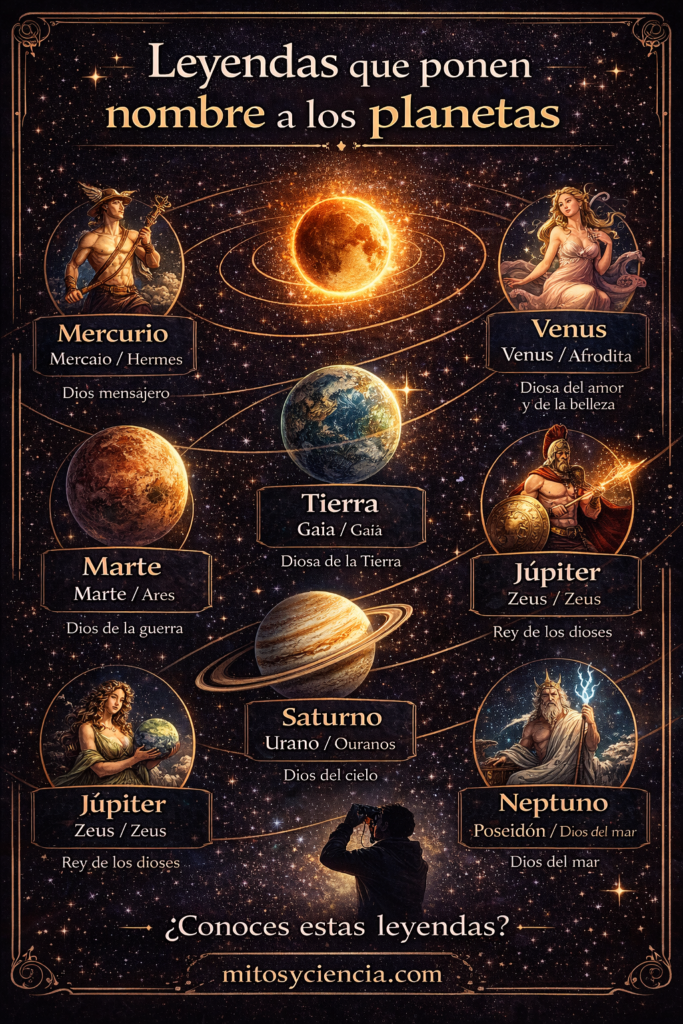
Frequently asked questions about the names of the planets
Who decided we’d use the Roman names instead of the Greek ones?
No single person did. It was historical momentum. Latin was the language of science and scholarship across Europe for centuries, so when Renaissance astronomers started cataloging the sky systematically, they reached for the Latin names already embedded in European culture.
Why did the later discoveries, Uranus and Neptune, stick with the tradition?
Consistency, and a bit of respect. When Herschel found Uranus and wanted to call it George, the scientific community recognized that it would break the harmony of the sky. They decided that if the universe was going to be a pantheon, the same cast should keep getting invited. It’s a tradition that helps the solar system feel like one connected whole.
Are there planets named after goddesses besides Venus?
In the main solar system, Venus is the only one. Out in the asteroid belt and among the dwarf planets, though, there are plenty. Ceres was the first asteroid ever discovered and carries the name of the goddess of agriculture. Eris, Haumea, and Makemake are dwarf planets named for deities from a range of cultures. We’re balancing out Olympus little by little.
What is the Sun’s name in mythology?
To the Greeks it was Helios, crossing the sky each day in a chariot of fire. The Romans called him Sol Invictus. Interestingly, our word sun comes down through Old English and its Germanic roots rather than through a proper name the way the planets did. It’s important enough that it simply is the name.
Why is our galaxy called the Milky Way?
This is one of my favorite legends. The story goes that Hera was nursing Heracles, and when she woke and realized the baby wasn’t hers, she pulled him away sharply. A spray of milk shot across the sky and created the pale road we see on dark nights. It is, quite literally, a road of divine milk.
Why do people say the planets influence your mood?
It comes from the ancient medical theory of the four humors, which got mixed together with astrology. Jupiter, or Jove, gave us jovial, because his influence was thought to bring cheer. Saturn gave us saturnine, meaning gloomy or severe. Mercury gave us mercurial, for someone whose mind changes by the minute. English is full of astrology.
Which planet is the oldest by name?
Cronus, meaning Saturn, is technically the oldest in the mythological family tree, since he fathered the generation of Olympian gods. Uranus is the grandfather, though, so he’d take the prize for elder of the sky.
Is any planet named after a mortal?
Not in the traditional solar system. They’re all gods. There are thousands of asteroids named for real people, though, from Freddie Mercury to Malala Yousafzai. It’s our way of saying humans can reach the stars too.
Why is Pluto so small if the god was so important?
It’s a lovely paradox. In the myths, Pluto’s kingdom was vast and invisible, hidden under the ground. The fact that the planet is small and so far away we can barely see it fits that idea of a secret, mysterious realm perfectly.
What are Mars’s moons called?
Phobos and Deimos. They sound harsh, don’t they? Both come from Greek and mean fear and dread. They were sons of Ares, meaning Mars, and they went with him onto every battlefield. There’s something ironic about such a small planet having escorts with names that heavy.
Is any planet named after an animal?
Not directly, though plenty of constellations are. In some ancient cultures, including China, the planets were tied to celestial animals. Jupiter, for instance, was linked to the Azure Dragon of the East.
Is it true that Venus spins backward?
Yes, and mythologically it could not be more fitting. Venus is the goddess who breaks the rules, the one who makes the world turn differently once love gets involved. While the other planets rotate one way, she decided to go the other. The rebel of the glamour department.
Well, we just covered millions of miles without leaving the porch. Wars, love affairs, betrayals, and a discovery made with nothing but arithmetic. For me, learning where the planet names came from is like learning the last names of my neighbors. All of a sudden the block feels a lot friendlier.
Now I want to hear from you. If you had to pick the planet whose legend matches where you are in life right now, which would it be? Are you a radiant Venus, a Mercury running at full tilt, or maybe a Saturn hunting for patience and wisdom?
Had you heard about the little girl who named Pluto? Or the drama of the Juno probe keeping watch over Jupiter? Tell me whichever detail stuck with you, or any mythological question still rattling around in your head. I love reading your comments and figuring this universe out together, since it never stops surprising us.
Leave me a comment below and let’s get this conversation farther out than Voyager. See you among the stars.