An intimate, close-up journey through the galaxies. What they are, how they formed, why there are billions of them, where Earth sits inside the Milky Way, and how all of it can change the way you look at the night sky.
Galaxies, a conversation with the universe
I like to think that every time we look up at the night sky, we’re opening a window onto time. You don’t need to understand the formulas or memorize the numbers to feel something stir inside you, something that connects you to what you’re seeing. When I look at that darkness scattered with points of light, I feel like the galaxies are calling me by name. They remind me that I’m not alone, that I’m part of something enormous and full of stories.
What galaxies are, the great homes of the cosmos
A galaxy is, when you get down to it, a giant home. Not just any home, but one where hundreds of billions of stars live alongside clouds of gas, interstellar dust, star clusters, and structures that look like they came straight out of a dream. Picture millions of suns dancing together, each one with its own worlds turning around it. That’s a galaxy: a cosmic neighborhood where everything is held in place by gravity.
Ours, the Milky Way, is just one of more than a trillion galaxies in the observable universe. To us, though, it’s special, because our whole story lives inside it: our Sun, our memories, our planet. Yes, that small blue dot we sometimes forget to appreciate, tucked into one of our galaxy’s spiral arms like a quiet house on a street full of stars.
A look at their history, from chaos to harmony
The first galaxies appeared when the universe was very young. Picture the total chaos after the Big Bang: a dense soup of energy and particles that didn’t quite know what to do with itself yet. Little by little, gravity started organizing all that disorder.
Giant clouds of hydrogen and helium formed first. Then certain regions collapsed and gave rise to the first stars. Those stars lit up the universe when they were born, and when they died, they seeded it with new elements.
That’s how the first galaxies started to take shape: small, clumsy, irregular. Over time they merged with one another, growing, shifting form, and building more defined structures. When I think about that, about billions of years of silent evolution, I realize galaxies are like gardens that have been tending themselves since the very beginning.
How galaxies form
Building a galaxy is a slow process, so slow that no civilization could ever watch the before and the after. Even so, the short version goes something like this.
First there’s gas, a lot of gas. Enormous clouds of hydrogen and helium that start drifting toward each other as if they had something important to say. When one of those clouds collapses, stars begin to be born, and every new star adds light and heat to the space around it.
Those stars live for millions or even billions of years. Some end their lives quietly, others go out in an explosion with a force that’s hard to imagine. Every one of those blasts scatters new elements across space. That’s the reason rocky planets, oceans, and bodies like ours exist at all.
A galaxy is exactly that: an endless cycle where matter transforms, gets recycled, and is born again. There’s something almost poetic about the idea that galaxies breathe in their own way.
Types of galaxies, cosmic personalities
Every galaxy is one of a kind, but astronomers usually sort them into three big families.
Spiral galaxies
These are the most familiar and, to me, the most beautiful. They’re shaped like a disk, with arms that curve outward in a spiral, and it’s in those arms that young, bright, restless stars are born. The Milky Way is one of them.
Elliptical galaxies
These are older and calmer. They have no arms and no sharply defined structure. They’re usually made up of mature stars, which gives them a soft, even glow. It’s like looking at a dimmer light that somehow feels deeper.
Irregular galaxies
These are the surprises. They have no fixed shape, usually because they’ve been through collisions or close encounters with other galaxies. Sometimes they look like little smudges of light, other times like organized chaos.
Our galaxy, the Milky Way
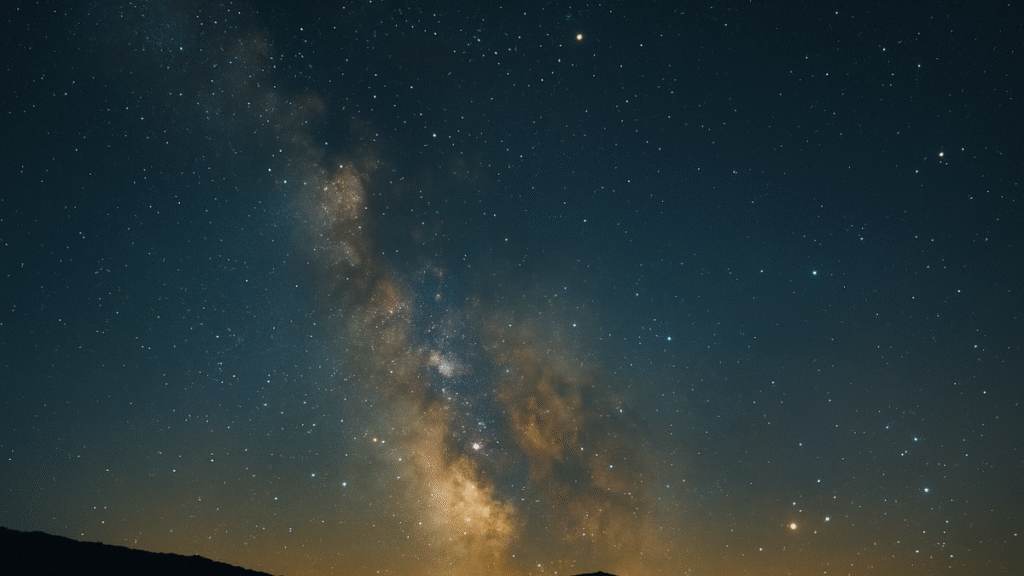
Talking about the Milky Way means talking about home. Picture an enormous disk with a bright center. We’re out in that disk, on one of its arms, the one we call the Orion Arm. Earth is right there, circling our star, this small blue oasis we sometimes forget to appreciate.
The Milky Way holds somewhere between 100 billion and 400 billion stars, and any one of them could have planets of its own. When I think about how many worlds might be out there, it gives me chills.
At the center of our galaxy sleeps, or rather beats, a supermassive black hole called Sagittarius A*. It isn’t the devouring monster people sometimes picture. It’s simply another part of the galactic structure, a dark heart with everything turning around it at an incredible pace.
Earth, our home, goes around the Sun once a year. The Sun, meanwhile, takes roughly 230 million years to complete a single lap around the center of the Milky Way. In other words, our solar system has barely finished one orbit since dinosaurs walked here. There’s something beautiful about Earth being part of a cosmic journey so long that no civilization will ever see the whole of it.
The Milky Way by the numbers
Approximate diameter: 100,000 light-years
Stars: between 100 billion and 400 billion
Age: about 13.6 billion years
Structure: barred spiral
Center: a supermassive black hole
Earth’s location: the Orion Arm, far from the core
Other galaxies we know
We live in the Milky Way, but we’re far from alone out here. We belong to the Local Group, a small neighborhood of roughly 80 known galaxies.
Andromeda
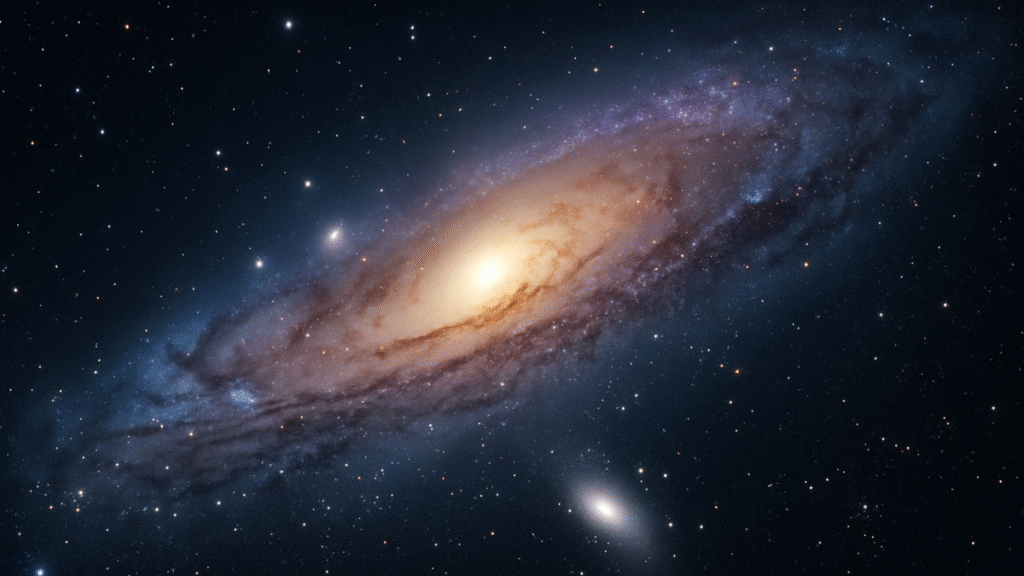
The closest large spiral to us and the biggest galaxy in the group. It’s so similar to the Milky Way that we could call it our big sister. It’s drifting toward us little by little, and in about four billion years the two of them will merge.
The Triangulum Galaxy
Smaller, but wide awake. It’s a factory turning out young, brilliant stars.
The Magellanic Clouds
Visible from the Southern Hemisphere. They’re like small traveling companions circling the Milky Way.
Past the Local Group there’s a genuine ocean out there. The universe is packed with shapes, colors, and sizes that are hard to picture: the Whirlpool, the Sombrero, the Cartwheel, the Antennae. Every one of them tells a different story.
How many galaxies are there in the universe
For a long time the number people threw around was 100 billion galaxies. Deep observations from telescopes like Hubble and James Webb suggest the real figure could be ten times higher. We’re talking about more than a trillion galaxies, each one holding hundreds of billions of stars.
Sometimes I try to imagine all those lights switched on at once, all those possible worlds, all those stories we haven’t heard yet. It’s too big to hold in your head, but there’s real comfort in knowing that beauty has no limit.
The most famous galaxies
Andromeda
The Sombrero
The Whirlpool
The Cigar
IC 1101, one of the largest ever found
Each one is like a city seen from above. Some are blazing with light, others are quieter, but they all hum with life.

The role galaxies play in the universe
Galaxies aren’t just collections of stars, they’re the basic building blocks of the cosmos. Without them, the universe would be far too thin and chaotic a place for life to get a foothold.
Stars, planets, nebulae, and all the structures that make our existence possible take shape inside them. It’s as if every galaxy were a laboratory where the universe runs experiments on itself.
Galaxies and black holes
The bond between a galaxy and its central black hole is a close one. For years the assumption was that galaxies gave birth to their black holes, but the evidence now points to the two of them growing up together, like a pair of dancers who have been partners since the story began.
The future of galaxies
Galaxies aren’t immortal. They change, they warp, they merge. Billions of years from now, the Milky Way and Andromeda will begin a slow dance that ends in a spectacular merger. It won’t be a violent crash, since stars sit so far apart that they’ll almost certainly never collide, but the orbits and the structure of both galaxies will be changed forever.
I like to think that in that distant future, even though none of us will be around to see it, some kind of consciousness will look up and see a brand-new galaxy made from two that were once neighbors.
Frequently asked questions about galaxies
What is a galaxy?
A huge system of stars, gas, dust, and dark matter held together by gravity.
How many galaxies are there?
More than a trillion, according to current estimates.
Where in the galaxy is Earth?
In the Orion Arm, a relatively quiet stretch of the disk, far from the central bulge.
Why are there different types of galaxies?
It comes down to their age, their history of collisions, how much gas they hold, and how they’ve evolved.
Do galaxies collide?
Yes. It’s common, and it’s a natural part of how the universe grows.
Looking at the sky with new eyes
Sometimes galaxies feel like letters written by the universe. Each one holds a different story and, somehow, they all belong to the same one.
When you look up, you’re not seeing the present, you’re seeing the past. The light from those stars and galaxies has traveled for millions of years to reach your eyes. So when you take in a distant galaxy, you’re looking at something that happened an unimaginably long time ago.
There’s something deeply magical about that, as if the universe sent us messages late but they still arrived at exactly the right moment.
What do you feel when you think about galaxies?
When I remember that I live inside a galaxy, I get a mix of calm and awe. Part of me feels tiny. Another part feels lucky to be here, in this small corner of the cosmos called Earth, floating like a held breath inside the Milky Way.
Maybe that’s why galaxies have the power to shift our perspective. They remind us that life is fragile, and also incredible. That darkness doesn’t mean emptiness, it means possibility. That even though we’re small, we’re part of something immense.
If you ever feel lost, remember this: you belong to a galaxy that has been here for billions of years, and the matter you’re made of was forged in the hearts of stars that died long ago. You’re not an accident, you’re cosmic history.
Galaxies are the most beautiful reminder that the universe knows how to make beauty out of chaos. Each one is a story written in light, and we’re living inside one of them, traveling among billions of stars without even noticing.
I’d love to know what you feel when you look at the sky, or when you think about the Milky Way. Does it inspire you, make your head spin, calm you down? Tell me in the comments, I’d love to read it.