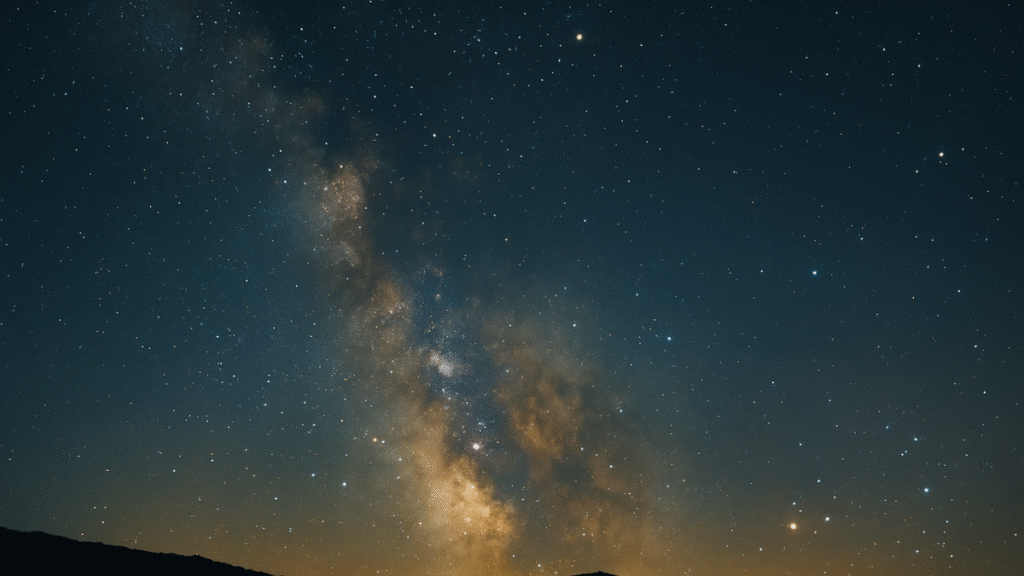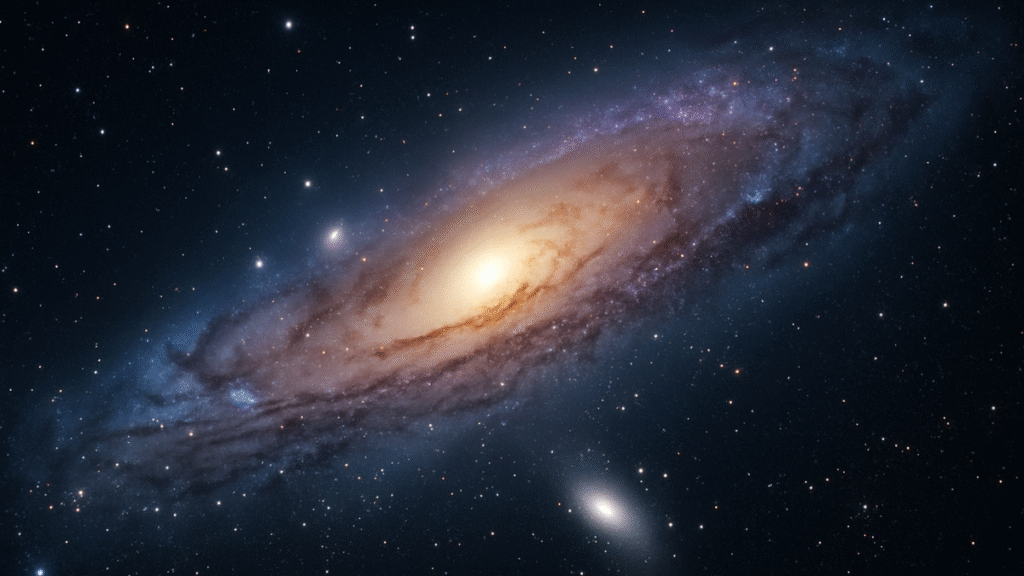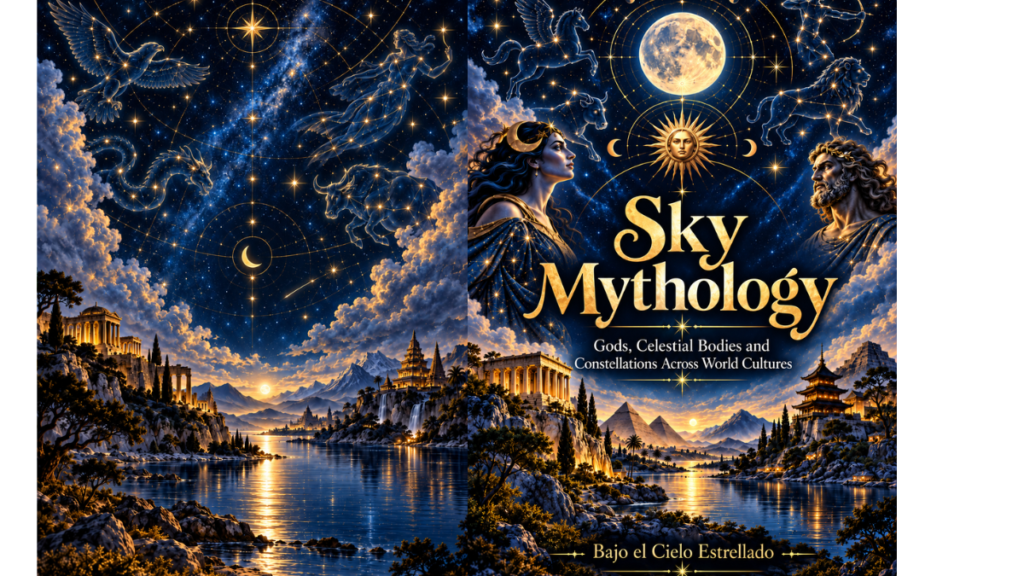
Discover Sky Mythology, a book of gods, love stories, and legends about the Sun, the Moon, and the constellations from cultures around the world.
Ever since humans first looked up at the sky, it has been much more than a vast space filled with stars. It has been the backdrop for impossible love stories, encounters between gods, eternal rivalries, and legends that have survived for thousands of years. Every civilization found in the Sun, the Moon, and the constellations a way to understand the universe, but also a way to express their own feelings, fears, and hopes.
That fascination with the sky and the stories our ancestors imagined while gazing at it is where Sky Mythology. Gods, Stars, and Constellations Across World Cultures was born. This book invites readers to travel through the mythological traditions of different peoples and discover that behind many of the stars we know, there are extraordinary stories waiting to be told.
This isn’t simply a collection of ancient legends. It’s a narrative journey through the beliefs, love stories, and conflicts that different cultures projected onto the night sky. Throughout its pages, mythology meets astronomy, history, and poetry to recover a way of looking at the sky that we have largely forgotten.
This post contains affiliate links. Please see the disclosure.
When the Sun and the Moon were gods, lovers, and enemies
Today we know that the Sun is a star and that the Moon is our planet’s satellite. We understand their movements, can predict eclipses, and explain the phenomena that for centuries inspired both fear and wonder.
Long before telescopes and modern observatories existed, though, our ancestors had already found their own answers to the mysteries of the sky.
For many civilizations, the Sun and the Moon weren’t just celestial bodies. They were divine beings who experienced passions similar to our own. In some traditions they were lovers condemned to live apart. In others, they were siblings locked in conflict, or spouses whose union kept the universe in balance.
In Greek mythology, for example, Selene, the goddess of the Moon, fell deeply in love with Endymion, a beautiful mortal shepherd. Their story raises one of the great paradoxes of mythological love. How can an immortal goddess love someone destined to grow old and die? The answer leads to an eternal sleep, silent encounters under moonlight, and one of the most delicate legends of antiquity.
Very different is the story of Coyolxauhqui, the Aztec moon goddess, whose confrontation with her brother Huitzilopochtli represents a cosmic battle between night and day. Her legend, deeply tied to the religious beliefs of pre-Columbian Mexico, reminds us that the stories written in the sky aren’t always about love and tenderness. They can also speak of violence, sacrifice, destruction, and rebirth.
In Japan we find Amaterasu, the great solar goddess of Shinto, who chose to hide in a cave after suffering the aggressions of her brother Susanoo. Her disappearance plunged the world into darkness and forced the other gods to find a way to bring light back to Earth. It’s a fascinating tale that, beyond its religious meaning, invites reflection on pain, isolation, and the ability to recover joy.
These stories, along with the Inca traditions of Mama Killa and Inti, the Chinese legends of Chang’e, the Norse gods Sól and Máni, and tales from other cultures, make up the first part of the book. This section is dedicated to exploring how the peoples of the world interpreted the relationship between the two great protagonists of our sky.
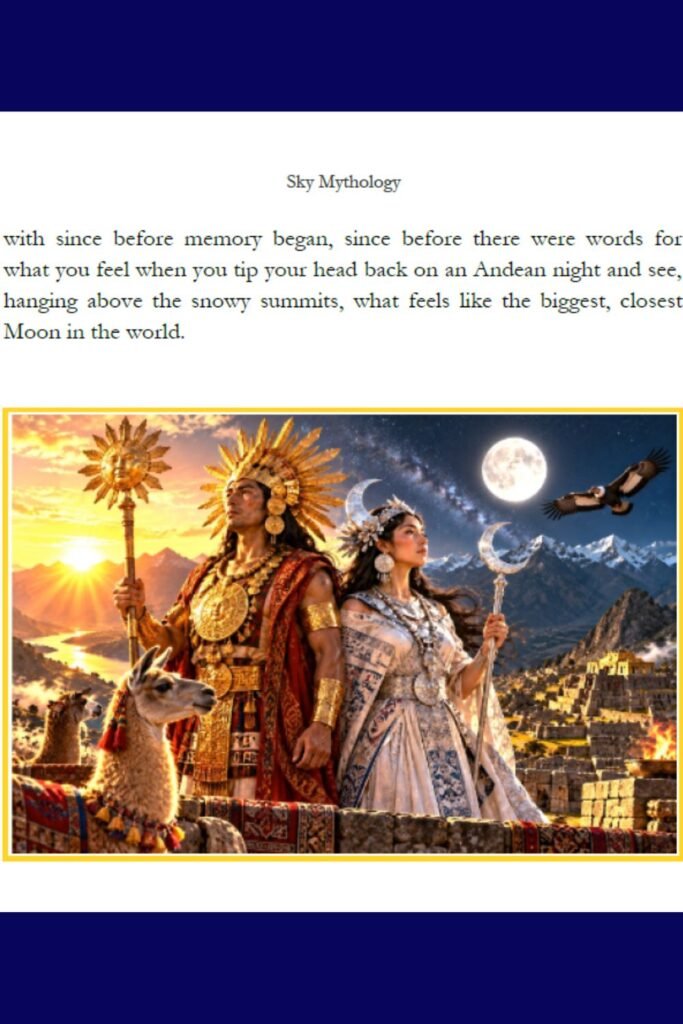
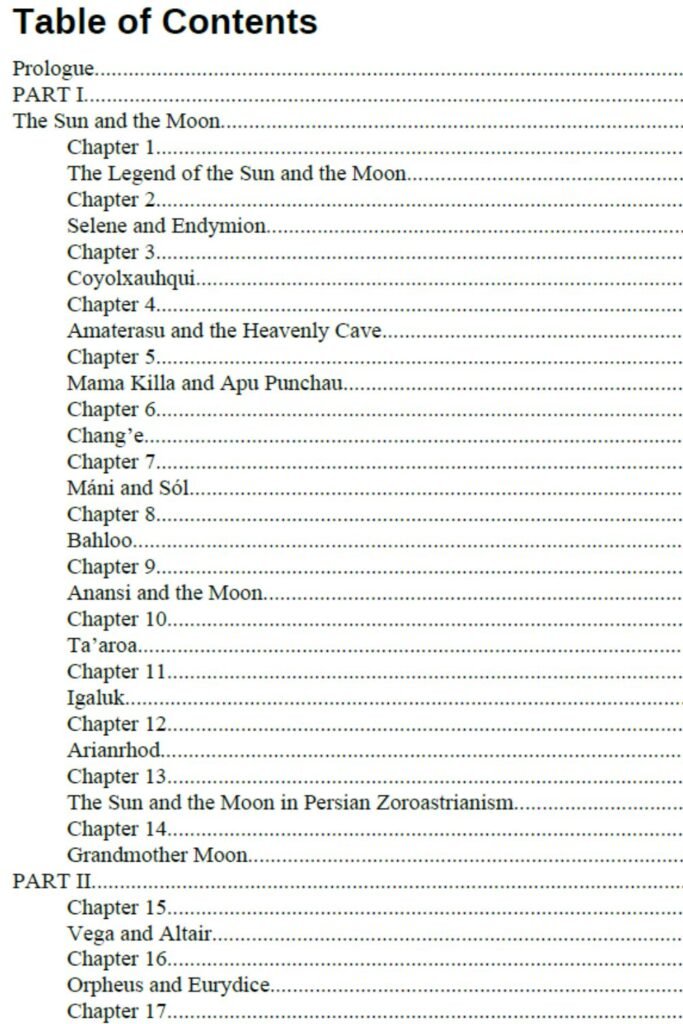
A few pages from the book
Impossible love stories written among the stars
Love has been one of the great driving forces of mythology around the world. Gods fall in love with mortals, lovers defy divine prohibitions, and some couples are separated by forces that not even death can overcome. But there are stories where that separation takes on a truly cosmic dimension.
One of the most beautiful comes from Chinese tradition and is connected to Vega and Altair, two bright stars we can see on summer nights.
According to legend, a celestial weaver and a cowherd were separated by the Milky Way, turned into a vast river that kept them from being together. Their love was so deep that the magpies, moved by their suffering, once a year formed a bridge with their wings so the two could meet.
The story has traveled across centuries and borders, giving rise to celebrations and traditions that still carry their romantic meaning in several Asian countries.
In Sky Mythology we also find the tragic love of Orpheus and Eurydice, one of the most well-known tales in Greek mythology, as well as the stories of Radha and Krishna in Indian tradition, the divine relationship between Ix Chel and Kinich Ahau in the Maya world, and the tragedy of Deirdre in ancient Irish legend.
Each of these tales presents a different vision of love, but they all share something in common. The human need to imagine that our feelings can transcend time, distance, and even death.
As readers move through them, they discover that the sky wasn’t only a calendar to track the seasons or a guide for navigators. It also became a vast stage where peoples performed their most intimate stories.
The constellations. Heroes, pursuits, and eternal tragedies
When we look at a constellation, we see a group of stars that, from our perspective, seem to form a recognizable shape. For ancient peoples, though, those shapes were far more than an exercise in imagination.
The constellations preserved the memory of gods, heroes, sacred animals, and legendary events. Each one had a story that explained why its stars held a particular place in the sky.
Orion, one of the most famous figures in celestial mythology, was an extraordinary hunter whose fate became forever linked to a scorpion. His legend speaks of pride, strength, and the consequences of defying the order the gods had set.
The Pleiades, that small cluster of stars visible within the constellation of Taurus, represent seven sisters pursued by Orion in Greek tradition. But their story doesn’t belong exclusively to the Mediterranean world. Among the Aboriginal peoples of Australia, we find the tales of the Kungkarangkalpa, ancestral women whose journey was reflected in the sky and in the landscapes of Australia.
It’s especially fascinating to see how cultures separated by enormous geographic distances developed different stories around the same group of stars.
We also discover Cassiopeia, the queen punished for her vanity. Callisto, transformed into a bear and lifted into the sky. The Swan, connected to the metamorphoses of Zeus. The Hyades, linked to the celestial region of Taurus.
The book expands this journey with legends from Irish tradition, folk interpretations like the Three Marys of Orion’s Belt, and tales associated with Canopus, also known as Suhail in the Arab astronomical tradition.
In this way, the constellations stop being distant, silent figures and recover the voices of those who gazed at them long before we did.
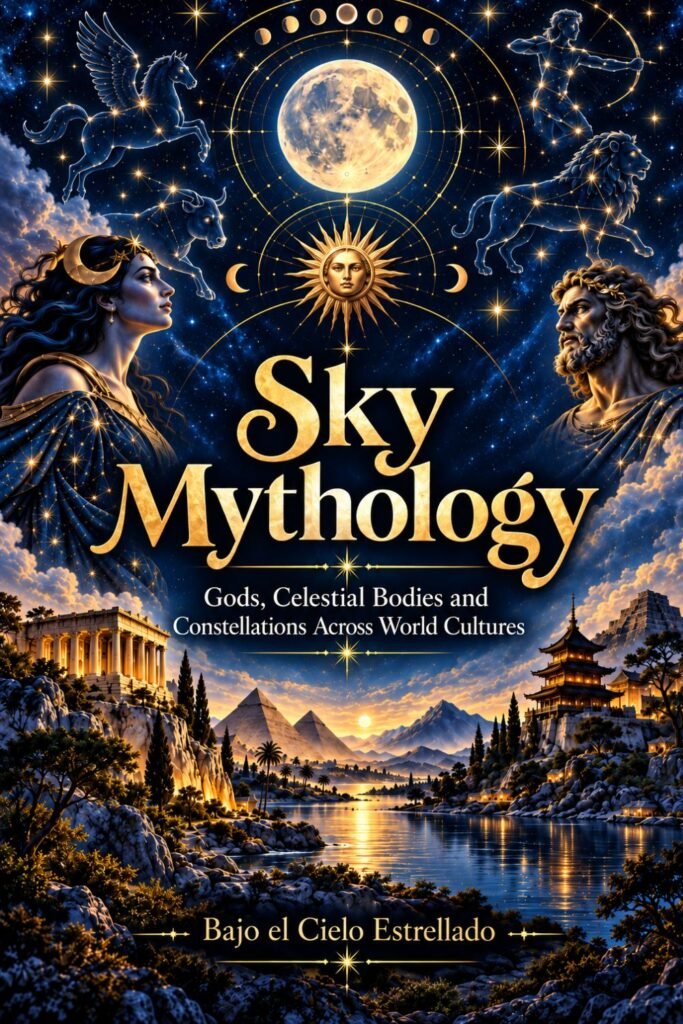
Book cover
A journey through world cultures under one shared sky
One of the most compelling aspects of Sky Mythology is the diversity of traditions it brings together. Greek mythology tends to get the spotlight in books about constellations, but the night sky has been interpreted by virtually every human civilization.
The ancient Incas recognized in the Milky Way not only figures formed by bright stars, but also animals represented by the large dark patches of interstellar dust. For them, those silhouettes had a deep connection to nature, agriculture, livestock, and the cycles that governed everyday life.
In northern Europe, the Norse peoples imagined the Sun and the Moon crossing the sky while being chased by wolves destined to catch them during Ragnarök, the end of the world.
In Arctic traditions, the movements of celestial bodies were tied to family stories and supernatural pursuits. In Africa, legends linked to Anansi and other mythical figures offered different ways to explain the mysteries of the night. In the Pacific Islands, tales of great creator deities placed the origin of light and the sky within a complex vision of the universe.
This diversity helps us understand that humanity has never looked at the sky in just one way. Each people interpreted it through their own land, their experiences, and their beliefs, turning the stars into an essential part of their cultural identity.
Where mythology meets astronomy
Science allows us to understand what stars actually are, how the Moon was formed, why eclipses happen, and what apparent movements explain the position of constellations throughout the year.
Mythology, on the other hand, shows us how those phenomena were interpreted by societies that didn’t yet have the tools to study them scientifically.
These two perspectives are different, but they can enrich each other. Knowing that the Pleiades form a star cluster doesn’t take away the emotional power of the seven sisters’ stories. Understanding the phases of the Moon doesn’t diminish the beauty of the legends that imagined her wounded, pursued, or reborn each night.
That’s precisely where much of the book’s appeal lies. In the chance to look at the same phenomenon through the lens of scientific knowledge and through the imagination of people who lived hundreds or thousands of years ago.
A book for anyone fascinated by the stars and ancient legends
Sky Mythology. Gods, Stars, and Constellations Across World Cultures is written for those who enjoy discovering mythological tales, for astronomy enthusiasts who want to learn the cultural stories tied to the night sky, and for readers interested in the beliefs and traditions of ancient civilizations.
Across its 31 chapters, divided into three major sections, the book takes readers on a journey that begins with legends of the Sun and the Moon, continues with love stories separated by the stars, and ends by exploring the heroes, tragedies, and mythical figures that gave meaning and names to countless constellations.
The narratives blend literary retellings of myths with historical, cultural, and astronomical references, making it possible to enjoy the stories while gaining a deeper understanding of the context in which they were born.
The illustrations throughout the book help bring to life this universe of solar deities, moon goddesses, legendary heroes, and impossible encounters.
Looking at the stars with new eyes
We live in an era where we understand the universe far better than our ancestors did. We’ve sent probes to other planets, photographed galaxies millions of light-years away, and discovered phenomena that would have been unimaginable to the earliest civilizations.
Yet despite all those advances, we still feel something hard to put into words when we look up at a truly starry night.
Maybe it’s because the stars remind us how small we are against the immensity of the cosmos. Or maybe it’s because, even after thousands of years, we’re still asking some of the same questions that inspired the ancient myths.
Why are we here? What is our place in the universe? Is there anything that can survive the passage of time? Why do we find such beauty in objects that are impossibly far away?
Our ancestors answered those questions by creating stories of gods, lovers, heroes, and supernatural creatures. Those tales have reached us as part of an extraordinary cultural heritage that deserves to be known and preserved.
Sky Mythology is an invitation to recover that way of seeing, to remember that every star can hold a story and that behind many constellations lie centuries of imagination, belief, and human emotion.
Maybe after reading it, on a summer night you’ll no longer see Vega and Altair as two simple points of light separated by the Milky Way. You might remember the lovers who waited an entire year to be reunited. When you spot the three stars of Orion’s Belt, you might picture the great hunter of ancient legend walking eternally across the sky.
Sky Mythology. Gods, Stars, and Constellations Across World Cultures is available on Amazon for anyone who wants to explore this fascinating journey through the legends that different civilizations wrote, with their imagination, across the night sky.