Discover the full moon names month by month, where they come from, what they mean, and the special events like the blue moon, the supermoon, the micromoon, the blood moon, and the black moon.
Some topics show up without warning. One day you hear about the pink moon, another day somebody mentions the strawberry moon, and before you know it you’re studying a lunar calendar like there’s a little story tucked into every month.
To me it’s one of those curiosities that starts out pretty and ends up having far more to it than you’d expect.
Full moon names are simple and very human. They’re traditional names that come from watching the natural world: the seasons, the animals, the harvests, the cold, the flowers, the way the year keeps shifting.
Underneath it all, they’re about something we used to do a lot more of and now forget: paying attention.
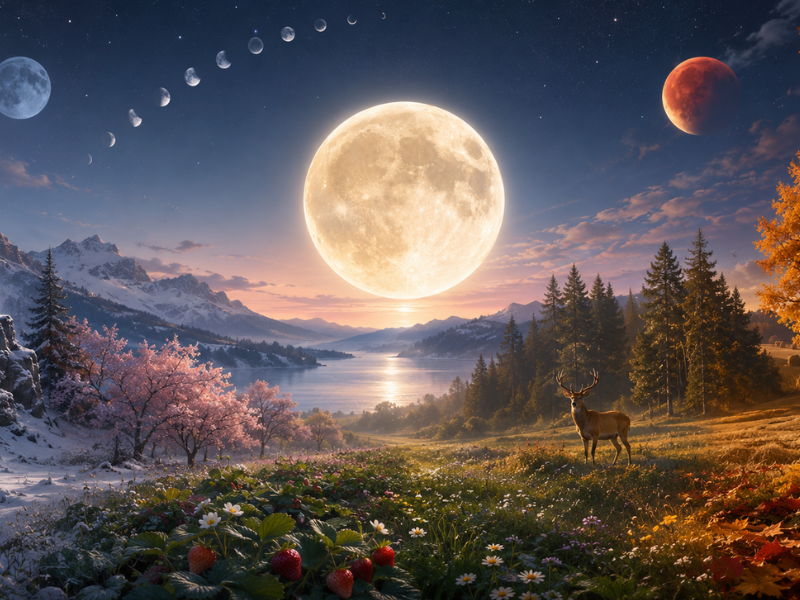
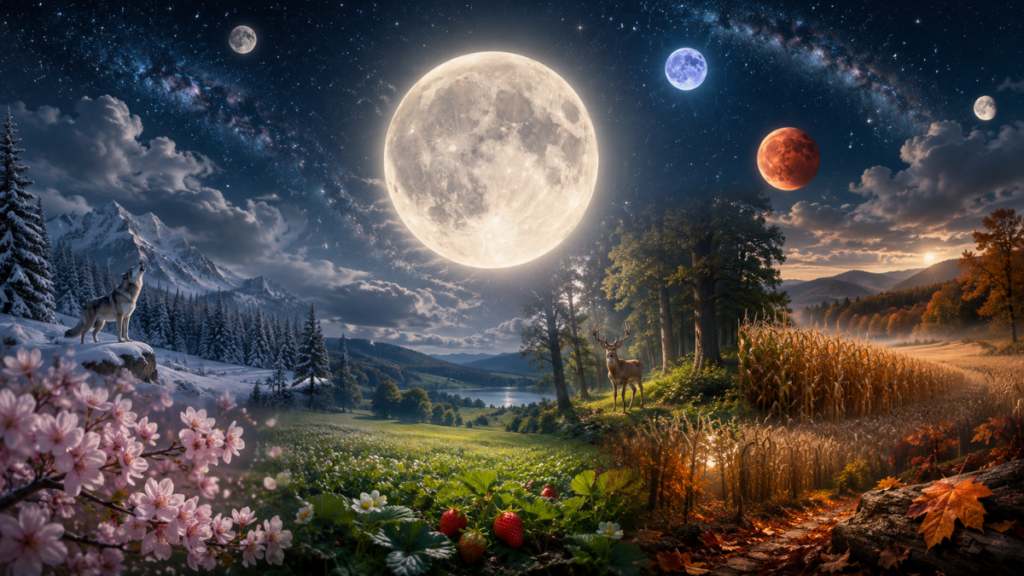
The images in this post were created for illustrative purposes with the help of AI
The pink moon usually doesn’t look pink. The strawberry moon doesn’t show up in the sky looking like fruit. The wolf moon doesn’t mean you’ll hear howling in your neighborhood that night.
The names still make sense, because they don’t describe how the moon looks. They describe the time of year it shows up. They’re small markers that remind us what was happening on the ground when that full moon lit up the night.
Once a month, the sky gives us an excuse to look up and ask how we’re doing, what’s changed, what needs tending, what we can let go of.
A quick look, a breath, and a reminder that we have cycles too, even with our calendars, our screens, and our hurry.
What full moon names are
Full moon names are the popular, traditional, or folk names used to identify each month’s full moon. Many of the best-known ones come from farming traditions, old almanacs, and Native American peoples, though there are European influences in there as well.
So when we talk about the wolf moon, the pink moon, the strawberry moon, or the harvest moon, we’re not using official astronomical terms. We’re using names that came out of watching daily life and the natural world.
That distinction matters, because the two get mixed up. Astronomy studies the Moon scientifically. It deals with lunar phases, orbits, eclipses, perigee, apogee, and plenty of other concepts.
Traditional full moon names belong somewhere else: to culture, oral tradition, the farming calendar, and the way people have made sense of time passing.
Not being official doesn’t make them any less valuable. Part of the charm is exactly that. These names weren’t born in an office or on a technical chart. They came from looking at the sky and the ground at the same time. They came from noticing that one month brought heavy snow, another brought certain plants into bloom, another meant picking fruit, another changed the way the animals behaved.
Every name paints a scene. The snow moon takes us to cold nights and white landscapes. The flower moon puts us in the middle of spring, when everything seems to open up.
The harvest moon is about fields, work, fruit, and getting ready for the months ahead. The cold moon reminds us the year is closing, the nights are long, and it’s time to bundle up.
There’s something lovely in the way these names invite us to see the calendar differently. Not just as a run of Mondays, bills, appointments, and reminders.
It becomes a living cycle full of small signals. The full moon shows up every month, but giving it a name changes how you see it. It turns into a kind of companion for the year.
Why every full moon has a different name
Every full moon has a different name because every month has its own character. January isn’t June. April isn’t November. September brings a different light than February.
We may live pretty disconnected from natural rhythms these days, but the year keeps changing around us. The temperature changes, the light, the plants, the animals, the food in season, even our own energy.
Traditional full moon names came straight out of that observation. In a lot of communities, the moon was how people kept track of time. They didn’t look up only because it was beautiful. They looked up because it was useful.
It helped them find their place in the calendar, plan farm work, get ready for the cold, recognize planting and harvest seasons, and understand the cycles of nature.
The snow moon, for example, is tied to February because across much of the northern hemisphere that meant heavy snowfall. The worm moon goes with March, when the ground started to soften and signs of life appeared below the surface.
The flower moon makes sense in May because that’s when blooming peaks. The strawberry moon belongs to June because it lined up with strawberry picking season in some regions.
These names are about the surroundings. They aren’t random labels. They reflect what people saw, needed, and remembered. That’s why they shift from one culture, region, and tradition to the next.
Not every region has the same animals, the same crops, or the same weather. A moon tied to snow in one place might line up with a completely different landscape somewhere else.
That variety is part of what makes it interesting. It reminds us that the lunar calendar isn’t a closed list. It’s a way of looking. We can use the most popular names as a starting point and still notice what’s happening right where we live.
Maybe for one person the April moon is the pink moon by tradition, but also the orange blossom moon, because she lives surrounded by orange trees. Someone else might feel like the September moon is the moon of fresh notebooks, new routines, and starting over.
Full moon names give us a beautiful base, but they don’t have to pull us away from our own experience. If anything, they can make it more conscious.
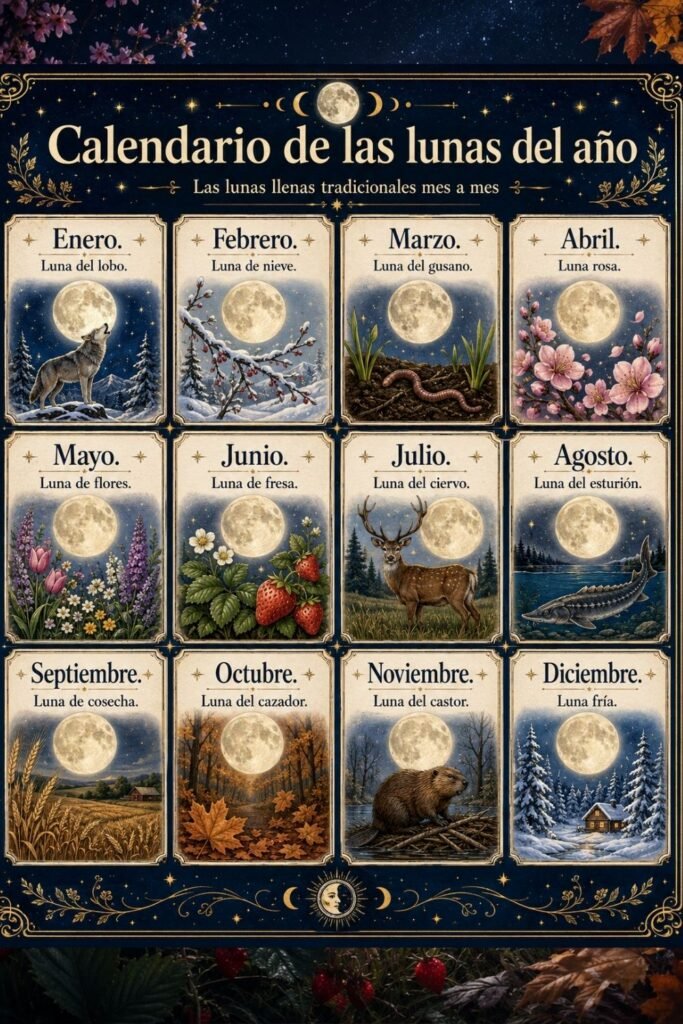
Traditional full moon names month by month
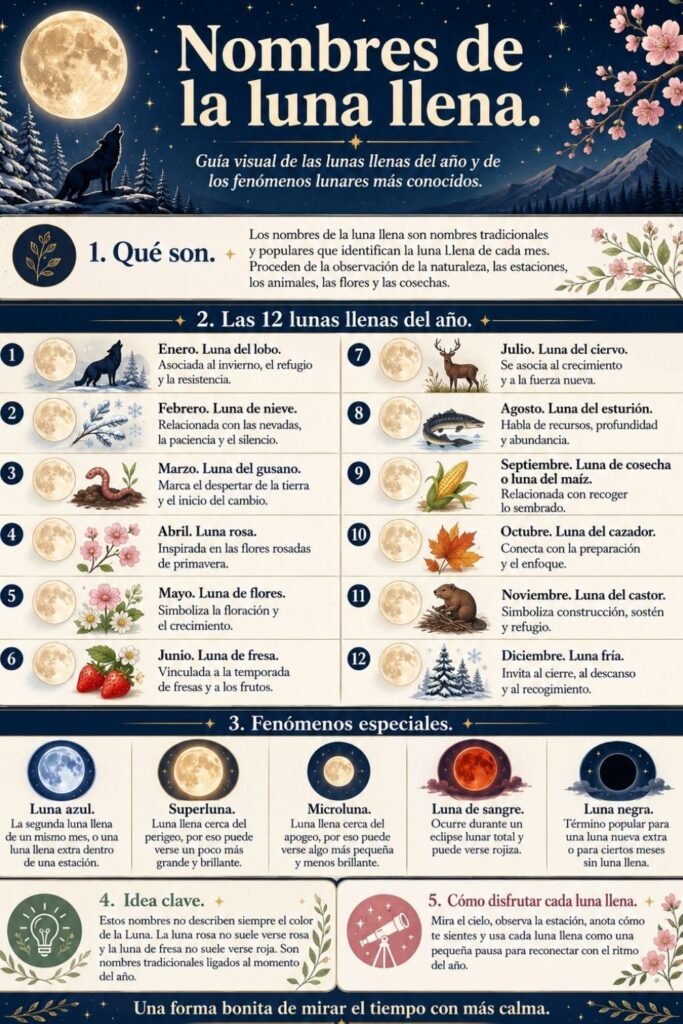
Here’s the full tour of the best-known full moon names across the year. The list shifts depending on the source, but these are the popular names you’ll find in most current lunar calendars.
For each month, we’ll look at the traditional meaning and an easy way to connect it to everyday life.
January: Wolf Moon
January’s full moon is known as the wolf moon. It’s one of the most powerful, evocative names on the lunar calendar. The origin has to do with cold winter nights, when wolves could be heard howling more often near some settlements.
In the depths of winter, with less food around and harsh temperatures, those howls were part of the season’s soundtrack.
The wolf moon is about cold, endurance, and survival. January tends to be a demanding month, even when we start it full of hope. We’re coming off the holidays, the close of a year, obligations, big meals, mixed feelings, and suddenly there’s all this pressure to start strong. The wolf moon suggests a gentler approach. Shelter first, momentum later.
February: Snow Moon
February’s full moon is known as the snow moon. The name comes from the heavy snowfall this month used to bring across much of the northern hemisphere.
Some traditions have also called it the hunger moon, because February could be an especially hard month to find food. Winter stores were running low and spring hadn’t arrived yet.
The snow moon has a quiet energy. Snow covers the landscape, softens the edges, muffles the noise, and changes how everything looks.
Life hasn’t disappeared under that white layer. It’s still there, waiting for its moment. I find that image really useful for understanding February. Sometimes it looks like nothing is happening, and underneath, plenty is getting ready.
March: Worm Moon
March’s full moon is known as the worm moon. It may not sound as pretty as the pink moon or the flower moon at first, but the meaning is lovely once you sit with it.
The name has to do with the moment the ground starts to soften after winter and earthworms, or other signs of life, turn up below the surface.
March is a month of transition. The cold starts to ease, the days stretch out, spring gets closer. There can still be rain, mud, and sudden temperature swings, but something is starting to move. That’s the whole point of this moon. The change doesn’t announce itself. It happens underground first.
April: Pink Moon
April’s full moon is called the pink moon. It’s one of the best known and also one of the most confusing. It isn’t called that because the Moon necessarily looks pink. The name comes from a pink wildflower, creeping phlox, that bloomed in early spring across parts of North America.
The pink moon is about opening up, spring, and first blooms. April usually brings a different quality of light. The air changes, the days get longer, and nature starts showing itself with more confidence.
After March’s first stirrings, April is more visible. What was sprouting starts to show.
May: Flower Moon
May’s full moon is known as the flower moon. The meaning is pretty clear: May tends to be a month of heavy blooming across much of the northern hemisphere.
After the first shoots and April’s gentle opening, May arrives with more presence, more color, and more visible life.
The flower moon is associated with growth, fertility, beauty, and natural expansion. You don’t have to take that anywhere grand. Just look around. More light, more plants, more movement, more reason to be outside. Spring isn’t hinting anymore. It’s here.
June: Strawberry Moon
June’s full moon is called the strawberry moon. The name is tied to strawberry picking season in parts of the northern hemisphere. It’s one of the most popular names because it sounds close, sweet, and very connected to the start of summer.
One thing worth clearing up right away. The strawberry moon doesn’t mean the Moon looks like a strawberry, or that it always turns reddish. It can look more golden, orange, or even a little red when it sits low on the horizon, but that depends on the atmosphere and where you’re watching from. The name comes from the harvest, not the color.
June has a particular energy. The days are long, the light stretches, and the year seems to open into something warmer. For a lot of people June brings plans, the end of the school year, vacation on the horizon, shifting routines, and a certain urge to take stock.
We’re almost halfway through the year, and even if we don’t think about it much, it registers.
July: Buck Moon
July’s full moon is known as the buck moon. The name has to do with the time of year when male deer start growing new antlers.
Antlers grow, fall off, and grow back, so this moon is closely tied to renewal, strength, and visible growth.
July usually means heat, more time outdoors, and for a lot of people vacation or a change of pace. It can also be a month when we feel more exposed. The buck moon is a good reminder that showing up fully is a kind of strength, not a risk.
August: Sturgeon Moon
August’s full moon is called the sturgeon moon. The sturgeon is a large, ancient fish that was easier to catch in certain areas this time of year, especially in North American lakes and rivers.
The name may feel less familiar than the pink moon or the strawberry moon, but the meaning is interesting.
The sturgeon moon is about resources, depth, abundance, and patience. The sturgeon belongs to deep water. It’s old and it’s durable.
August, for its part, tends to be a strange and very personal month. For some people it’s total rest. For others it’s working while everything else seems to have stopped. For a lot of us it’s a mix of heat, family, travel, tiredness, wanting to unplug, and a feeling of pause.
September: Harvest Moon or Corn Moon
September’s full moon is usually known as the harvest moon or the corn moon. One important detail: the harvest moon is the full moon closest to the fall equinox, so some years it lands in September and others in October.
Even so, September gets strongly associated with it, because it marks the end of summer and the start of a more inward stretch.
The harvest moon has a very practical meaning. Its light traditionally helped stretch the workday in the fields during picking season. It wasn’t just a pretty moon. It was a useful one. It lit up an important moment in the year, when there was gathering to do and months ahead to prepare for.
October: Hunter’s Moon
October’s full moon is known as the hunter’s moon. Traditionally, once the harvest was in, it was time to get ready for winter. The fields were clearer and game was easier to spot.
The name has to do with survival, foresight, and getting organized before the cold months.
Today we can read the hunter’s moon in a more symbolic, everyday way. October tends to be a clear month of transition. The light drops, afternoons get shorter, and the body starts to notice the year heading into its final stretch.
After September’s push, October may ask for more focus. Less scatter, more clarity.
November: Beaver Moon
November’s full moon is called the beaver moon. The name is tied to the season when beavers were building up their lodges for winter.
It also connects to old trapping practices, carried out before certain areas froze over. Beyond that context, we can hold onto the beaver as a symbol of building, shelter, and preparation.
November usually brings a more inward energy. The light fades, the cold starts to bite, and the year is winding down. It isn’t always an easy month. It can feel gray, slow, or heavy. The beaver moon suggests the answer isn’t to push harder. It’s to build something warm to come back to.
December: Cold Moon
December’s full moon is known as the cold moon. It also goes by the long night moon, mostly because of how close it falls to the winter solstice in the northern hemisphere. It’s a moon of closing, cold, darkness, and rest.
December is a loaded month. There are holidays, obligations, shopping, year-end accounting, family feelings, absences, memories, and expectations. We’re supposed to be happy the whole time, and the reality is usually a lot more mixed. There’s joy, sure, but also exhaustion, nostalgia, overload, or a craving for quiet. The cold moon doesn’t ask for more from us. It asks for rest, and there’s something freeing in that.
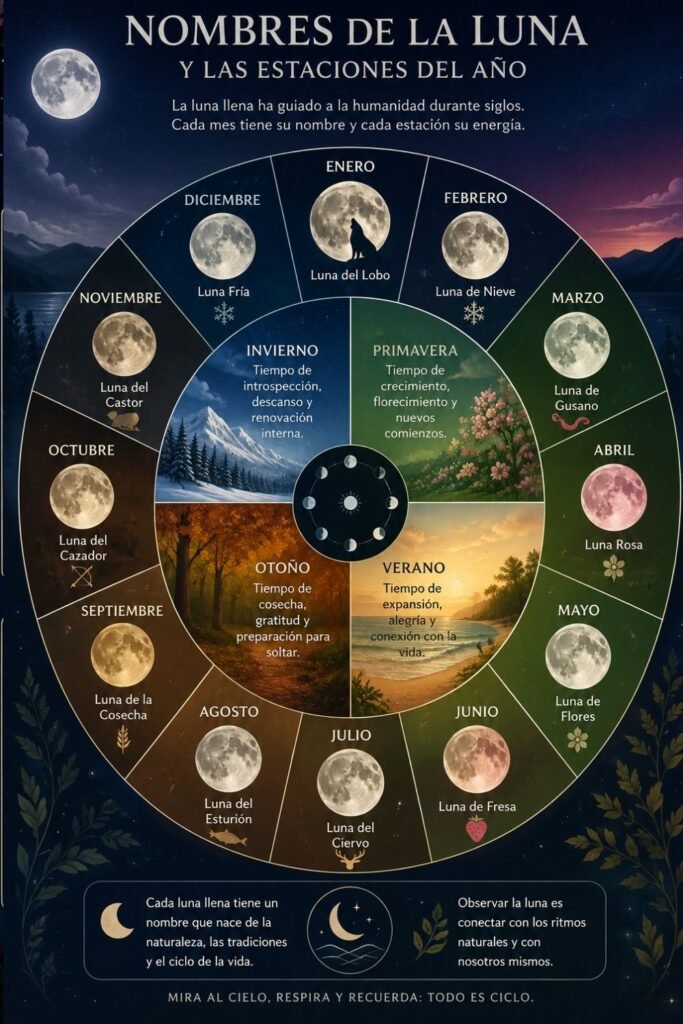
Full moon names at a glance
A summary like this helps, but it’s worth remembering there’s no single universal list. Many of these names spread through specific almanacs and traditions, mostly in the northern hemisphere.
Elsewhere, full moons can carry completely different names, because the nature, the climate, and the customs are different too.
The snow moon makes a lot of sense where February means heavy snowfall. Somewhere it never snows, the name is more symbolic than literal.
| Month or event | Name | Main meaning |
|---|---|---|
| January | Wolf Moon | Winter, shelter, endurance, and protection |
| February | Snow Moon | Cold, silence, patience, and rest |
| March | Worm Moon | The ground waking up, change, and first movement |
| April | Pink Moon | Spring, opening, pink blossoms, and renewal |
| May | Flower Moon | Blooming, growth, beauty, and expansion |
| June | Strawberry Moon | Strawberry season, fruit, enjoyment, and sweetness |
| July | Buck Moon | Growth, new strength, and presence |
| August | Sturgeon Moon | Resources, depth, abundance, and resilience |
| September | Harvest Moon or Corn Moon | Gathering what was planted, gratitude, and preparation |
| October | Hunter’s Moon | Focus, foresight, and getting organized before winter |
| November | Beaver Moon | Shelter, building, support, and care |
| December | Cold Moon | The close of the year, rest, calm, and quiet |
| Special event | Blue Moon | A second full moon in one month, or an extra full moon in a season |
| Special event | Supermoon | A full moon close to Earth, bigger and brighter than usual |
| Special event | Micromoon | A full moon farther from Earth, a little smaller and dimmer |
| Special event | Blood Moon | A total lunar eclipse in which the Moon can look reddish |
| Special event | Black Moon | A popular term for an extra new moon, or for certain months with no full moon or no new moon |
Special lunar events
Beyond the monthly full moon names, there are special events with very popular names of their own.
Some have to do with where the Moon sits relative to Earth. Others involve eclipses, or quirks of the calendar.
Blue moon
The blue moon is one of the best known, though the name is misleading. A blue moon usually doesn’t look blue. The term actually describes an extra full moon on the calendar.
The most popular definition says a blue moon is the second full moon within a single month. Since the lunar cycle runs about 29.5 days, some months can fit two full moons if the first one lands early and the second lands late.
That second full moon is the blue moon.
There’s an older definition too. By that explanation, the blue moon is the third full moon in a season that has four instead of three. It’s less familiar to most people, but some calendars still use it.
Either way, the main idea is that a blue moon is an extra full moon. Something slightly off the usual rhythm. That’s where the expression “once in a blue moon” comes from, used for anything that doesn’t happen often.
Supermoon
A supermoon happens when the full moon lines up with the Moon being near its closest point to Earth. That point is called perigee. Being closer, the Moon can look a little bigger and brighter than usual.
Headlines do tend to oversell supermoons. You won’t always look up and notice a huge difference. To the naked eye, the change can be subtle.
Even so, when a supermoon sits near the horizon, it can look especially beautiful and bright.
Supermoons caught on because they’re easy to enjoy. All you need is to know when one is happening, find a spot with a clear view, and look. Sometimes the simple thing is exactly what you want.
Micromoon
The micromoon is the opposite of the supermoon. It happens when the full moon lines up with the Moon being near its farthest point from Earth. That point is called apogee. So it can look a little smaller and dimmer than usual.
Micromoons don’t get nearly as much attention as supermoons. Fewer headlines, fewer spectacular photos, less buildup. I still think it’s a great phenomenon, because it reminds us of something important: not everything valuable has to be big, flashy, or obvious.
We live in a time when everything is supposed to stand out. Everything has to be visible, shareable, measurable, or talked about. The micromoon goes the other way. It’s there, quieter, farther off. Still a full moon, even if it doesn’t look as imposing.
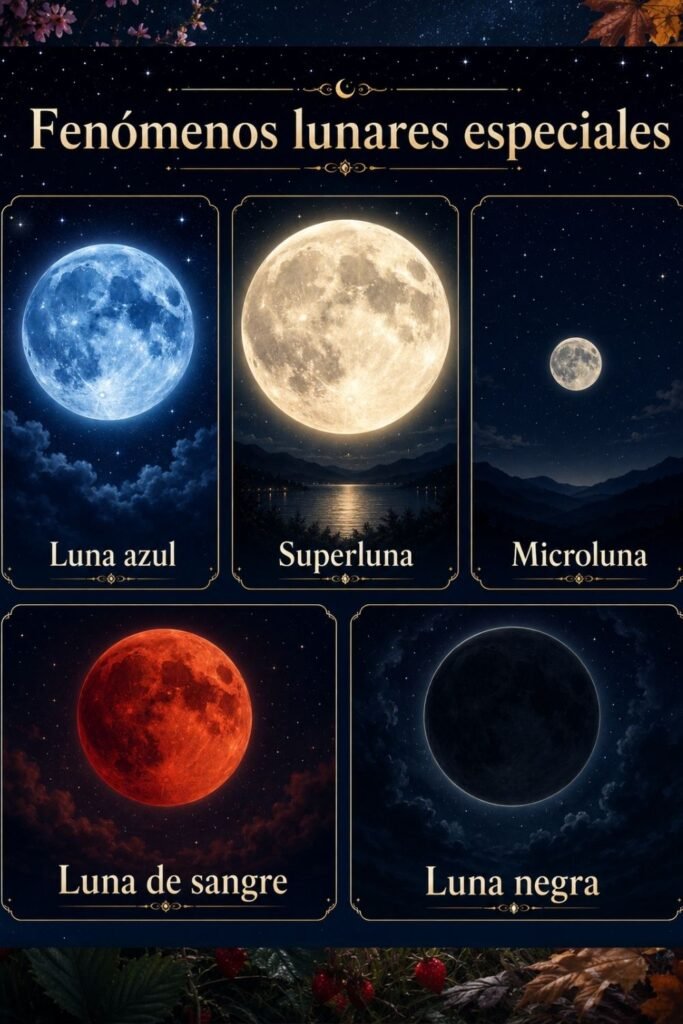
Blood moon
The blood moon shows up during a total lunar eclipse. Earth passes between the Sun and the Moon, and our shadow covers the lunar surface. Sunlight filtering through Earth’s atmosphere can give the Moon a reddish, coppery, or orange tone. Hence the name.
It’s one of the most striking lunar events out there. Seeing the Moon turn red is impressive even when you know exactly what’s going on. The science doesn’t take the beauty away. If anything, understanding it can make the whole thing feel more special.
Throughout history, lunar eclipses stirred up fear, respect, and fascination. That makes sense. Picture people in other eras watching the Moon change color in the middle of the night, and it’s easy to see why these events picked up so much meaning.
Today we know a blood moon doesn’t signal anything strange or dangerous. It’s a total lunar eclipse seen from Earth. We can still use the image symbolically if we feel like it.
Black moon
Black moon is a popular term with no single official definition. It gets used different ways depending on the calendar or the source. Sometimes a black moon is the second new moon within one month.
It can also mean a month with no full moon, which can only happen in February, since February is shorter than the lunar cycle. In other cases, it refers to a month with no new moon.
All that variety can be confusing, but the general idea has to do with absence, darkness, and invisible beginnings. A black moon doesn’t have the visual presence of a full moon. It’s tied to the new moon, to what can’t be seen, to what starts in silence.
That’s exactly why I like the concept. Not everything important is visible from the start. Plenty of things begin in a dark, quiet, almost secret stage. An internal shift, a decision you haven’t told anyone about, an idea that doesn’t have a shape yet, a need that’s slowly coming into focus.
The difference between full moon names and lunar phases
It’s easy to mix up traditional full moon names with lunar phases, so it’s worth pulling them apart. Names like pink moon, strawberry moon, wolf moon, or harvest moon refer to specific full moons within the year.
Lunar phases, on the other hand, describe how much of the Moon we see lit from Earth over the course of its cycle.
The Moon moves through several phases. The new moon happens when the side facing Earth isn’t lit. From there it grows little by little until it reaches first quarter.
Later comes the full moon, when we see the visible face completely lit. Then it starts shrinking down to last quarter, and finally back to the new moon.
Within that cycle there are in-between phases: waxing crescent, waxing gibbous, waning gibbous, and waning crescent. All of that belongs to the Moon’s natural motion around Earth and the way it catches sunlight.
Traditional names add a cultural, seasonal layer on top. Put simply, the pink moon is a full moon that happens in April. The strawberry moon is a full moon that happens in June. The wolf moon is a full moon that happens in January.
What changes isn’t the phase, since they’re all full moons. It’s the popular name given to each one based on the month and the tradition.
Understanding that difference makes the lunar calendar easier to enjoy. We can look at the astronomy and the symbolism both. One explains how it happens. The other tells us how people have lived it, named it, and remembered it.
Why we still love these names
Full moon names still appeal to us because they turn something we see often into something meaningful. The Moon is up there every month, and most of the time we don’t look.
Once you know that full moon has a name, a story, and a link to the season, your attention shifts.
Naming something changes how you see it. A flower is just a flower until you learn its name, and suddenly you spot it everywhere. You notice when it shows up, how it smells, what color it is, what memories it brings back.
Something similar happens with the Moon.
We also love them because they mix simplicity and depth so well. Strawberry moon sounds sweet, but it’s about gathering fruit.
Cold moon sounds blunt, but it’s about closing and resting. Wolf moon sounds fierce, but it’s about shelter and survival. Every name opens a door.
Simple ways to watch each full moon
Watching the full moon doesn’t take anything special. A window, a balcony, a patio, a quiet street, a park. What matters most is the attention you bring to it.
One easy idea is to catch the moon as it rises. Near the horizon it usually looks bigger, thanks to an optical effect, and it can take on a warmer tone.
You can also look up before bed and give the light a couple of minutes. If it’s cloudy and you can’t see a thing, no problem. The moon is still there.
You can watch with other people, too. Sometimes a conversation about this stuff opens up something nice. Asking someone which moon they like best, or what they’d name a moon of their own, is an easy way into talking about seasons, memories, and where you are in life.
Full moon names and the seasons
A nice way to understand full moon names is to look at them by season. The whole arc of the year comes through better that way, instead of each moon sitting on its own.
In winter we get the cold moon, the wolf moon, and the snow moon. These are moons of cold, rest, shelter, and endurance. They’re about long nights, protecting your energy, and accepting that some stretches of life happen on the inside.
Spring brings the worm moon, the pink moon, and the flower moon. These moons are about waking up, movement, opening, and growth. First the ground stirs, then the first colors appear, then the blooming really takes off.
Summer gives us the strawberry moon, the buck moon, and the sturgeon moon. These are moons of fruit, presence, strength, and resources. Summer brings more light, more exposure, and more contact with the world outside.
Fall brings the harvest moon, the hunter’s moon, and the beaver moon. These are moons of gathering, preparation, and building shelter. Fall isn’t only about leaves coming down. It’s about choosing what to keep, what to release, and what to get ready for winter. It’s a great season for sorting things out, closing loops, and getting back to the essentials.
Common myths about full moon names
Full moon names are lovely, and they also cause a lot of confusion. Some of it comes from flashy headlines, some from edited photos, some from taking the names too literally. Let’s clear up the most common ones.
The pink moon doesn’t always look pink
The pink moon gets its name from pink spring flowers, not because the Moon necessarily changes color. It can look more orange or red when it sits low on the horizon, but that can happen with any full moon and it depends on the atmosphere.
The name is about the season and the blooming, not a guaranteed color in the sky.
The strawberry moon doesn’t look like a strawberry
The strawberry moon is called that because it lined up with strawberry picking season in some regions. It doesn’t mean the Moon will look red, pink, or fruit-like.
It can pick up warm tones as it rises, but that isn’t what defines it. The name is about the harvest and the start of summer.
The blue moon usually isn’t blue
The blue moon isn’t named for a color. It normally refers to a second full moon within one month, or an extra full moon within a season.
It’s a calendar phenomenon, not a regular visual change. The Moon can look bluish under very rare atmospheric conditions, but that isn’t what makes a blue moon.
The supermoon doesn’t look enormous
A supermoon can look a little bigger and brighter because the Moon is closer to Earth, but the difference isn’t always as obvious as some images promise.
A lot of supermoon photos use lenses, framing, or perspective that exaggerate the effect. It’s still a beautiful moon to go out and see.
The micromoon deserves attention too
The micromoon usually goes unnoticed because it’s less showy than the supermoon. With the Moon farther away, it can look a bit smaller and dimmer. That’s exactly where its charm is.
It reminds us there’s beauty in the understated, and that not everything special needs to make a lot of noise.
The blood moon isn’t a warning
The blood moon happens during a total lunar eclipse, when the Moon can pick up reddish tones because of the way light passes through Earth’s atmosphere.
It may have been read with fear long ago, but we know now that it’s a natural astronomical event. It can be striking. It isn’t a sign of danger.
The black moon doesn’t have one definition
Black moon is a popular term, not an official lunar phase with a single explanation. It can mean a second new moon in a month, a month with no full moon, or a month with no new moon, depending on the context.
So it’s always worth checking which definition a given calendar or source is using.
Frequently asked questions about full moon names
What are full moon names?
Full moon names are the traditional or popular names used to identify each month’s full moon. They’re usually tied to nature, the seasons, animals, harvests, or the weather. They aren’t official astronomical names, but they’re part of tradition, and they help us see how people have tracked the passing year through the sky.
How many full moon names are there?
The best-known list has twelve main names, one for each month of the year. January is the wolf moon, February is the snow moon, March is the worm moon, April is the pink moon, May is the flower moon, June is the strawberry moon, July is the buck moon, August is the sturgeon moon, September is the harvest moon or corn moon, October is the hunter’s moon, November is the beaver moon, and December is the cold moon. On top of that, there are alternate names depending on the tradition, plus special names for events like the blue moon, the supermoon, the micromoon, the blood moon, and the black moon.
Are full moon names official?
Not in the astronomical sense. Astronomy uses technical terms for lunar phases, eclipses, orbits, and the position of the Moon. Names like pink moon or strawberry moon belong to folk tradition, almanacs, and the cultural habit of watching nature. Official or not, they’re still widely used and they carry real value as part of the folk calendar.
Does the full moon affect our emotions?
Plenty of people feel like the full moon helps them pay closer attention to their emotions, though that doesn’t mean it determines what we feel. It can work as a monthly reminder to stop, write, rest, or check in with yourself. Sometimes the valuable part isn’t finding an outside explanation. It’s giving yourself a moment to listen.
What all these names add up to
Full moon names are a lot more than a pretty list to save on your phone. They’re a way of remembering that the year has a rhythm, that nature changes, and that we do too. Every name brings an image, a season, and a question.
The wolf moon is about shelter. The snow moon is about patience. The worm moon is about the ground waking up. The pink moon is about opening. The flower moon is about growth.
The strawberry moon is about fruit and enjoyment. The buck moon is about new strength. The sturgeon moon is about deep resources. The harvest moon is about gathering what you planted. The hunter’s moon is about preparation. The beaver moon is about building shelter. The cold moon is about closing quietly.
Then there are the special events, which add even more texture to the lunar calendar.
The blue moon shows up as an extra full moon. The supermoon gives us a Moon that’s a little closer and brighter. The micromoon reminds us of the beauty in what’s understated.
The blood moon stuns us during a total lunar eclipse. The black moon is about invisible beginnings, about whatever is still taking shape in silence.
I’d love to know which full moon name is your favorite. Tell me in the comments, and say whether you connect more with the pink moon, the strawberry moon, the wolf moon, the harvest moon, or one of the special ones.
You can also tell me what you’d name a full moon of your own, based on your season, your city, or the way you live the year.