The seven most terrifying and fascinating black holes in the universe, from Sagittarius A* to the colossal TON 618. The real science, the Schwarzschild formula, and the secrets of the event horizon, in plain language.
I woke up today with the kind of energy that makes you want to understand everything. I was reading about the latest observations from the James Webb Space Telescope and got completely pulled in, pun intended, by black holes. These are the places where reality breaks down, where the physics we learned in school decides to take a permanent vacation.
I love the feeling of leaning over the abyss from the safety of my couch with a cup of coffee. So I put together this guide to what these space monsters actually are, how they form, and which seven are the most staggering ones we know about right now. Buckle up, because this trip is one-way.
| Name | Type | Mass (Suns) | What makes it stand out |
| Sagittarius A* | Supermassive | 4 million | The heart of our own galaxy, the Milky Way |
| M87* | Supermassive | 6.5 billion | The first one humanity ever photographed |
| Cygnus X-1 | Stellar | 21 | The first ever confirmed, picked up as an X-ray source in 1964 |
| TON 618 | Ultramassive | 66 billion | One of the most massive known; shines like 140 trillion Suns |
| The wanderer (MOA-2011-BLG-191) | Stellar | 7 | Drifting loose through the galaxy at 100,000 mph |
| J2157 | Ultramassive | 34 billion | The hungriest: it eats the equivalent of one Sun a day |
| The OJ 287 pair | Binary | 18 billion | Two black holes locked in orbit around each other |
What a black hole actually is
Let’s start with the basics, and skip the dictionary definitions that leave you exactly where you started. A black hole isn’t a hole in the sense of an opening or a tunnel, whatever the movies sell you. Picture taking something with enormous mass, the Sun for instance, and squeezing it, crushing it, compressing it until it’s the size of a small city.
What you get is a region of space with so much matter crammed into so ridiculously small a point that gravity loses its mind. It’s strong enough that not even light, the fastest thing there is, can claw its way out. That’s why they’re black. They neither reflect nor emit light. A perfect trap sewn into the fabric of spacetime.
I like thinking of them as the universe’s ultimate recyclers. Whatever falls in becomes part of them permanently.
How black holes are born
You’re probably wondering where these things come from. They don’t appear by magic. Most of the black holes we know about are the leftovers of giant stars that went out with quite a bang.
When a star far larger than our Sun burns through its fuel, it can no longer hold itself up. For millions of years that star lives in a standoff: energy from nuclear reactions pushing outward, gravity pulling inward. Once the fuel runs out, gravity wins.
The star collapses in on itself, violently. With enough mass behind it, that collapse never stops until it produces a singularity. The result is a supernova, the biggest fireworks display in space, with a newborn black hole sitting at the center of it. The star dies to become something much darker and far more powerful.
The science of the invisible, the Schwarzschild radius
Here’s where we get slightly technical. There’s a key idea called the Schwarzschild radius. In plain terms, it tells you how far you’d have to compress an object before it turns into a black hole.
Karl Schwarzschild was a physicist who solved Einstein’s equations while serving at the front in World War I, which is a level of focus I can’t imagine. He found that every mass has a limit. Squeeze that mass below its radius and gravity takes over, producing a black hole.
Here’s the formula that defines it:
Rs = 2GM/c²
Don’t let the letters scare you. Rs is the radius, G is the universal gravitational constant, M is the object’s mass, and c is the speed of light.
To give you a sense of how wild this gets: turning Earth into a black hole would mean compressing the entire planet down to a radius of about 9 millimeters. Smaller than a marble. Every mountain, every ocean, every city squeezed into something the size of a fingernail. That’s the kind of power we’re dealing with.

The event horizon, the point of no return
The event horizon is the black hole’s border. Cross that invisible line and there’s no coming back. Think of the lip of a waterfall. You can swim nearby, but past a certain point the current has you.
Here’s the strange part. If you were falling in, time would pass normally for you, while anyone watching from outside would see you freeze at that edge forever. Gravity that strong warps time itself. I find that fascinating and terrifying in equal measure.
1. Sagittarius A*, the quiet neighbor at the center of our house
We’ll start with the closest one, in galactic terms anyway. Sagittarius A*, pronounced Sagittarius A-star, is the supermassive black hole sitting right in the heart of the Milky Way. It’s about 26,000 light-years away.
What gets me about Sagittarius A* is that it’s our monster. It carries the mass of roughly 4 million Suns. Sounds like a lot, and in the world of supermassive black holes it’s practically a toddler. For decades we knew it was there because we could watch the surrounding stars whipping around in a frenzy, orbiting what looked like nothing at all. Then in 2022, thanks to the Event Horizon Telescope, we finally saw its shadow.
It’s a constant presence. Without it sitting there, our galaxy probably wouldn’t have the shape it does. It’s the anchor holding everything together while we ride around out here on our spiral arm.
2. M87*, the first face of the abyss
If Sagittarius A* is the neighbor, M87* is the Hollywood A-lister. It lives in the galaxy Messier 87 and comes in around 1,500 times more massive than ours. We’re talking 6.5 billion times the mass of the Sun.
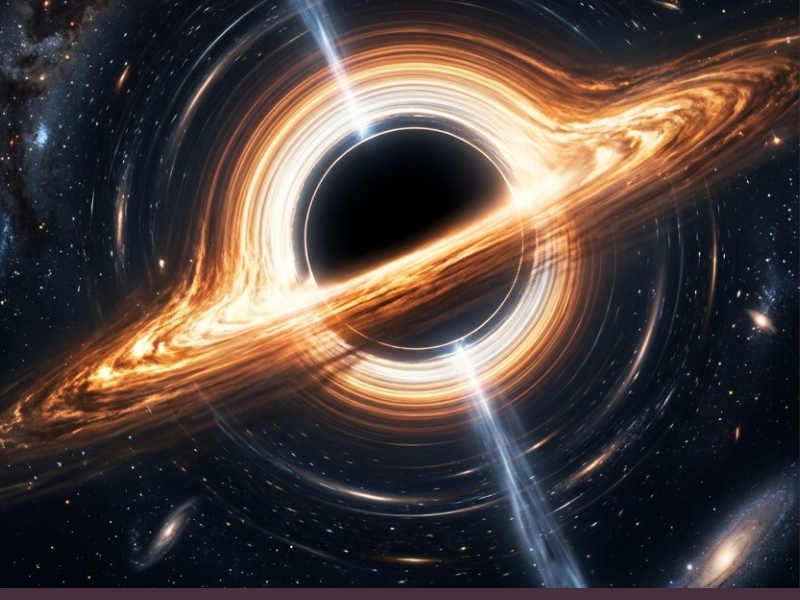
This was the first black hole in history to be photographed, back in 2019. You definitely remember that image of a blurry orange ring. That ring is the accretion disk: gas and dust whirling at close to light speed, heating up so much that it blazes before being swallowed.
The most impressive thing about M87* is its plasma jet. It fires material outward at nearly the speed of light, producing a beam thousands of light-years long. A cosmic cannon punched through space. Seeing that photo for the first time was a historic moment, science finally confirming that Einstein had it right even under the most extreme conditions imaginable.
3. Cygnus X-1, the first discovery that rewrote the rules
This one is special out of pure scientific nostalgia. Located in the constellation Cygnus, the Swan, Cygnus X-1 turned up as a powerful X-ray source in 1964 and became the first object science accepted as a black hole in the early 1970s.
The interesting wrinkle is that Cygnus X-1 isn’t a supermassive giant parked in a galactic core. It’s a stellar-mass black hole, and it’s literally eating a companion star, a blue supergiant. Gas streams off the star toward the black hole, forming a whirlpool that throws off X-rays like crazy.
There was a famous bet between Stephen Hawking and Kip Thorne over whether Cygnus X-1 was really a black hole. Hawking took the no side as a kind of insurance policy, in case the life he’d spent studying them turned out to be a mistake. He eventually had to concede he’d lost. I love picturing these two geniuses needling each other over who understood the sky better.
4. TON 618, the undisputed king of cosmic terror
If the last few made you feel small, hold on tight. TON 618 isn’t just a black hole, it’s an ultramassive quasar. Basically the final boss of the universe.
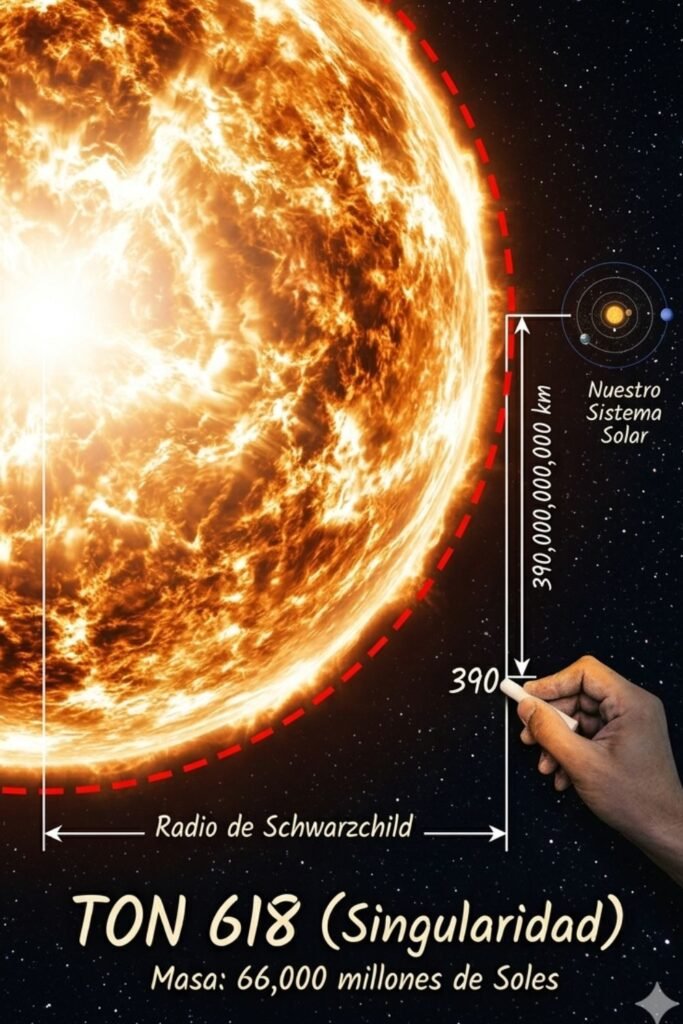
Its mass runs to 66 billion times the Sun’s. It’s so large that its Schwarzschild radius, remember the formula, comes to roughly 195 billion kilometers, about 120 billion miles, which makes it around 390 billion kilometers across. To picture it: you could drop our entire solar system inside it over and over and still have room to spare in every direction.
It shines with the intensity of about 140 trillion Suns. It’s so far away that what we see today happened more than 10 billion years ago. Looking at TON 618 is looking into the deepest past of existence. It’s so massive that scientists still aren’t sure how it managed to grow that big in so little time after the Big Bang. That’s the biggest open question hanging over us.
5. The wandering black hole, invisible and on the run
For a long time we assumed black holes always sat at the centers of galaxies or stayed put in binary systems. Then in 2022, the Hubble Space Telescope confirmed something that chilled everyone: there are black holes drifting alone through our galaxy.
This one is a stellar-mass object, roughly 7 times the Sun’s mass, traveling at about 100,000 miles per hour. How do you find something invisible? Through an effect called gravitational microlensing. The black hole passed in front of a distant star, and its gravity bent that star’s light, making it brighten and shifting its apparent position. It’s like tracking a ghost through the woods by watching how the branches bend. One of the most elegant detections in the history of astronomy, if you ask me.
6. J2157, the insatiable glutton of the cosmic dawn
If TON 618 is the most massive, J2157 is the hungriest. It’s a quasar discovered fairly recently, carrying about 34 billion times the Sun’s mass. What’s genuinely frightening is its growth rate: it eats the equivalent of one Sun every single day.
Think about how much material it has to swallow to keep that up. It’s so distant that we see it as it was when the universe was barely over a billion years old. Scientists find it a real puzzle, since nobody can explain how it packed away that much that fast after the Big Bang. The giant rebellious teenager raiding the universe’s pantry without asking.
7. The OJ 287 pair, a dance between two titans
To close out the list, a binary system in the constellation Cancer. There isn’t one black hole here, there are two supermassive ones orbiting each other. The larger runs about 18 billion solar masses, the smaller a mere 150 million.
The astonishing part is that the small one punches through the big one’s gas disk twice every twelve years, setting off flares brighter than a trillion stars. It’s a cosmic dance that ends, thousands of years from now, in a catastrophic collision that will shake spacetime with massive gravitational waves. The heaviest, most dangerous choreography in the known universe.
Frequently asked questions about black holes
What would happen if I fell into a black hole?
With a small one, you’d go through spaghettification: gravity at your feet would be so much stronger than at your head that you’d stretch like taffy until you came apart. With a giant like TON 618, you could cross the event horizon without noticing a thing, though once inside, the singularity is where you end up either way.
Could black holes swallow the whole universe?
Relax, no. Gravity depends on distance. If the Sun turned into a black hole this afternoon, Earth wouldn’t get swallowed. We’d keep orbiting exactly as we do now, though we’d freeze to death. It only takes you if you get too close to the event horizon.
Do black holes ever end?
Stephen Hawking showed they aren’t eternal. They give off an extremely faint glow called Hawking radiation. Over spans of time that dwarf the current age of the universe, they slowly evaporate until they vanish in a final burst. For something like TON 618, though, that endpoint is unimaginably far off.
Are they tunnels to somewhere else, like wormholes?
The math says they could be. Real physics says it’s close to impossible. Whatever falls in gets shredded and added to the black hole’s mass. Coming out the other side for tea in another galaxy doesn’t look likely, at least not in one piece.
Can you see a black hole with the naked eye?
No chance. They’re black because they don’t let light out. We only see them through their effect on what surrounds them, or through the glow of gas about to fall in.
From the 9-millimeter marble Earth would collapse into, all the way up to the monster that is TON 618. What stays with me is the sense that we’re a speck of dust in a universe full of invisible giants, and rather than frightening me, that makes me feel extremely lucky to be able to understand any of it.
Which of these seven surprised you most? Did you have any idea there were black holes roaming loose out there like the wanderer? Or did the one eating a Sun a day get you?
Don’t be shy, leave me a comment below.