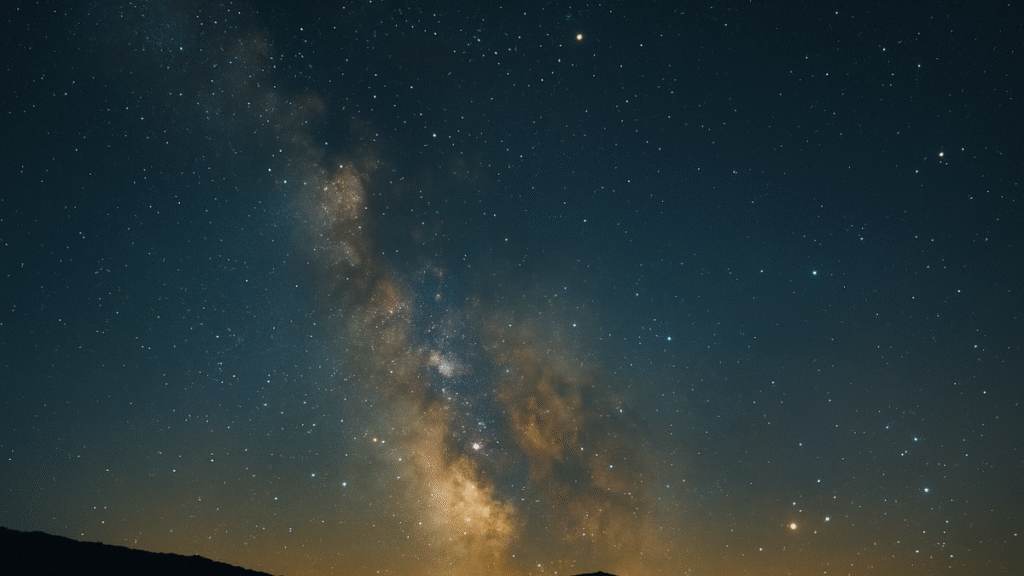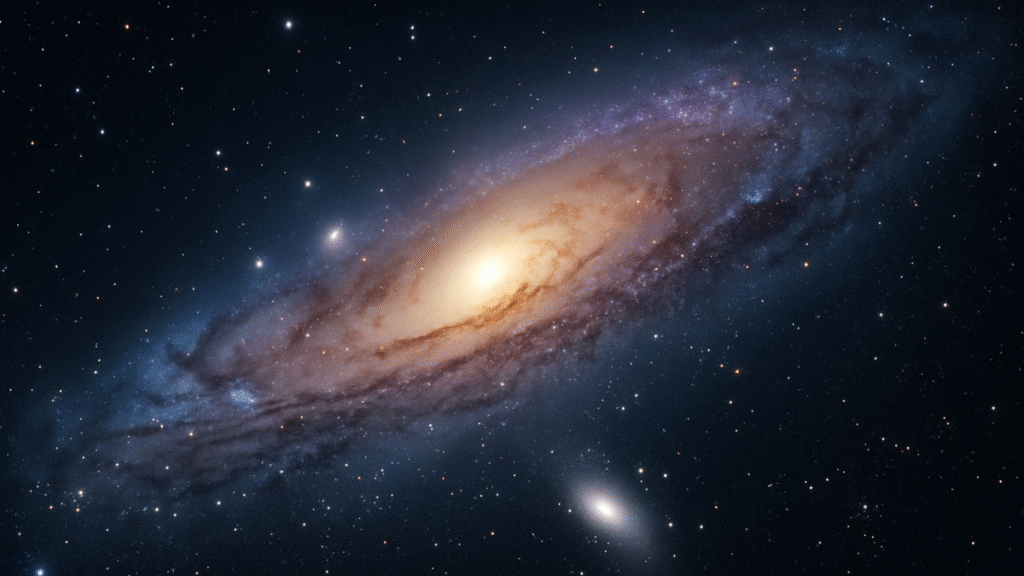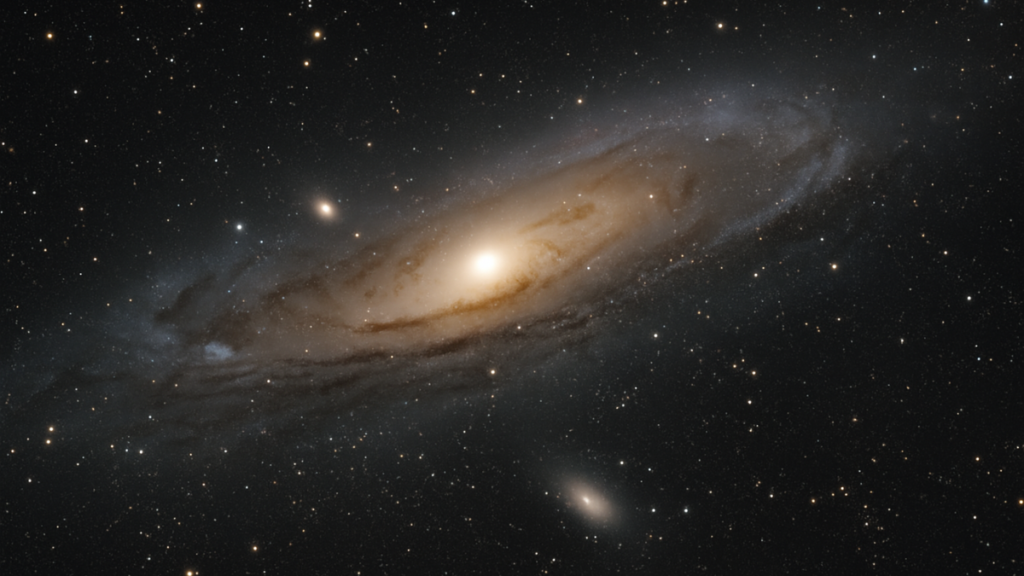
A complete guide to the Andromeda Galaxy: what it is, how to find it with your own eyes, what we know about its history, and why the famous crash with the Milky Way is no longer a sure thing.
The Andromeda Galaxy, cataloged as M31, is a giant spiral and, broadly speaking, the Milky Way’s big neighbor in the Local Group, the gravitationally bound cluster of galaxies we happen to live in.
If the catalog name sounds cryptic, that’s fair. M31 comes from the list Charles Messier assembled in the 1700s, a classic roster of deep-sky objects that professionals and backyard observers have leaned on ever since to keep nebulae, galaxies, and clusters straight.
Andromeda is also roughly the most distant thing you can pick up with your naked eye from a dark site, no telescope involved. Sharp-eyed observers under exceptional skies sometimes push farther and catch M33 over in Triangulum, but Andromeda is the one almost anyone can get. It isn’t always easy. I’ll walk you through it.
Andromeda isn’t a concept. It’s an address. It sits at a specific spot in the sky, and once you learn to find it, it stops being a photo on the internet and turns into an experience. Looking at it is realizing the universe isn’t an abstraction. It’s a real place, with real neighbors, real histories, and a future that, to a lot of people’s surprise, isn’t written in permanent ink.
What the Andromeda Galaxy (M31) actually is
Andromeda is a giant spiral galaxy and, along with the Milky Way, the headline act of the Local Group. That group is our cosmic neighborhood: a collection of galaxies bound together by gravity, with two heavyweights and a crowd of smaller companions orbiting and interacting in ways that turn out to be genuinely interesting. Andromeda stands out because it’s close by astronomical standards, and because its size, mass, and structure make it a kind of external mirror for understanding how a big spiral works.
Messier compiled his catalog so he wouldn’t keep mistaking fuzzy objects for comets while he hunted. What he left behind is close to a sentimental map for anyone who gets hooked on the night sky. Andromeda landed at number 31. The label sounds clinical at first, then somewhere along the way M31 becomes a name you use with affection.
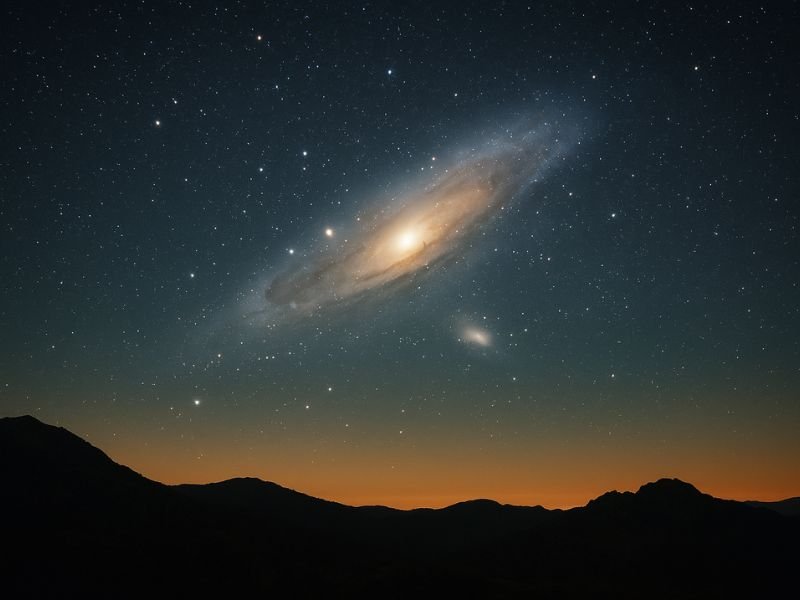
There’s one more thing that makes Andromeda special even if you’d never call yourself an astronomy person. You can see it without any equipment from a dark sky. It doesn’t look like the photographs, and it’s worth saying that up front, but it’s there. Standing in the dark knowing you’re looking at an entire galaxy with nothing but your eyes strikes me as one of the more elegant gifts the sky hands out.
How far away Andromeda is
Andromeda sits about 2.5 million light-years out. That number gets repeated constantly, and not as filler, because it carries something lovely and slightly dizzying: the light hitting your eye tonight left there roughly 2.5 million years ago. Looking at Andromeda is looking at deep history, a natural photograph made of traveling light.
That reframes the whole thing. You’re not observing an object as it is now. You’re reading an old message that has been crossing empty space for longer than our species has existed. It’s one of the reasons Andromeda gets under people’s skin. It drops you onto a timescale that makes you breathe differently.
How big Andromeda is
Andromeda is enormous, and depending on which measurement you weigh most, it can look bigger than the Milky Way or roughly comparable. The useful takeaway is that it’s a giant spiral in the same league as ours. That makes it especially good for comparing structure, because we experience the Milky Way from the inside, with everything that complicates about seeing the whole shape, while Andromeda we get to view from outside as a single object.
Here’s the detail that surprises people. Andromeda looks modest in the sky, but in angular terms it covers a lot of real estate. NASA puts its apparent size at around six times the diameter of the full Moon. The catch is that its light is spread thin across all that area, which is exactly why it reads as small. It’s big. Its glow is just soft.
Where Andromeda sits in the sky, and why it sometimes refuses to show up
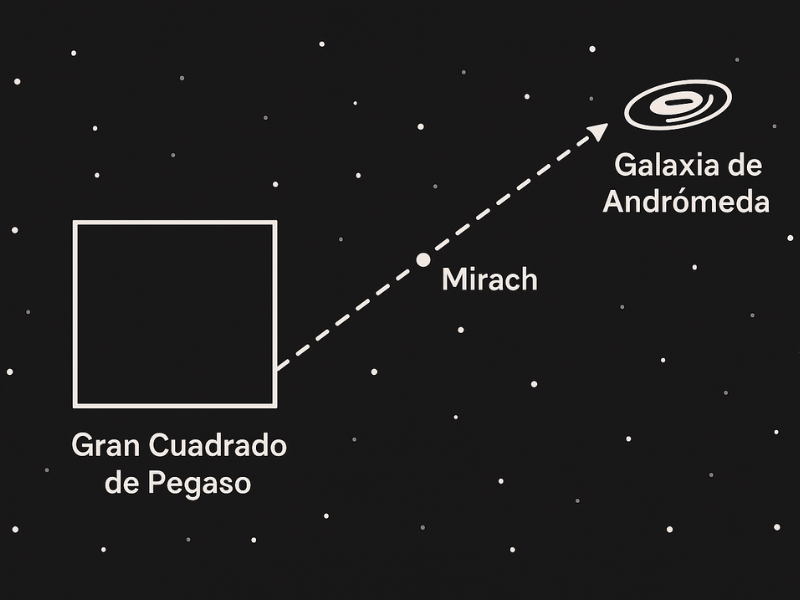
Andromeda lives in the patch of sky belonging to its namesake constellation, next door to Pegasus. The practical way in is usually the Great Square of Pegasus, since it’s an easy shape to recognize when the sky is halfway decent. From there the hop to M31 is a fairly forgiving star trail, with one tricky element that explains most of the frustration people run into.
Most people go looking for something bright. Andromeda doesn’t play that game. The core can pass for a fat little star, but the rest is a very faint elongated smudge. Add light pollution, a strong Moon, a streetlight down the block, or eyes that haven’t adjusted to the dark, and the contrast collapses. Andromeda evaporates. It’s still up there. Your eye just has no margin to work with.
This is the real gap between city and dark sky. In town you still see stars because a star packs its light into a single point. Andromeda spreads its light across a huge area, which gives it low surface brightness. In practice, light pollution hurts it far more than it hurts a bright star.
Finding Andromeda step by step, without the juggling act
Start by locating the Great Square of Pegasus. On a clear night from somewhere without much blocking the view, it’s usually the first shape to wink at you. Once you have it, find the corner of the square that connects to the chain of stars running out into Andromeda. That chain leads you toward Mirach, a star that’s easy enough to pick out when the sky cooperates.
From Mirach you make a short hop that becomes almost automatic with a little practice. There’s no need to turn it into an exam or memorize names like you’re studying a map. All you need to know is that you’re hunting for a small elongated cloud. The first time you land on it, it sticks, and the next night you’ll get there faster.
Binoculars help enormously here. Not because they work magic, but because they raise the contrast and funnel more light onto your retina. Through binoculars, Andromeda stops being a suspicion and becomes a shape. That step, going from “I think it’s there” to “I’m looking right at it,” is usually where people get hooked.
The best time of year to catch it, and why altitude matters
From anywhere in the lower 48, Andromeda is most rewarding in fall and early winter, when its stretch of sky rides high at reasonable hours. Altitude matters because an object higher up shines through less atmosphere, loses less contrast, and comes through cleaner. The difference between catching it halfway up the sky and hunting for it near the horizon can be the difference between seeing it and not.
The practical version is simple. A fall night with a thin Moon and no direct lights nearby is the ideal setup. A mountain sky or a small town without much glare makes it easy. A downtown balcony makes it hard. Andromeda isn’t being difficult. It’s physics.
Andromeda isn’t just a pretty galaxy, it’s a system full of stories
Treating Andromeda as a single object sells it short. A big galaxy is a complex system: structure, satellites, leftovers from mergers, regions where stars are forming, regions where star formation has shut down, an enormous halo, and enough dark matter to govern the whole dynamic. That complexity turns Andromeda into a natural laboratory for understanding how galaxies grow and change.
This is my favorite part, because it’s where the postcard idea falls apart. Andromeda is a process. It isn’t finished and it isn’t holding still. It has had encounters, swallowed companions, piled up material, reorganized its own structure, and it carries subtle scars that modern astronomy is getting better at reading.
Its best-known companions, M32 and M110
Andromeda has satellite galaxies. Two of the famous ones are M32 and M110, which show up near M31 in observations and photographs. Seeing them together shifts your framing, because it makes clear you aren’t looking at one thing but at a system with several members. It feels like looking at a city from a distance and picking out the smaller towns around it, all held in place by the same gravity.
That connects to something larger. The Milky Way has satellites too, the Magellanic Clouds among them. Big spirals don’t live alone. They live surrounded, interacting, pulling on each other.
The halo, the huge part nobody pictures
When people picture Andromeda, they picture the spiral disk. The disk is the photogenic part, and it isn’t the whole thing. Around it sits a gigantic halo of scattered stars and gas, plus the component that dominates the mass: dark matter. The halo matters because it’s part of the galaxy’s real size in gravitational terms.
None of that is decorative theory. The halo determines how Andromeda pulls, how it gets pulled, and how future trajectories play out across the Local Group. That becomes very relevant once we get to the supposed collision with the Milky Way, because orbits at that scale depend on masses that never show up in a photograph.
Stellar streams, the scars of its past
Andromeda shows clear evidence of past mergers, which is completely ordinary out there. Galaxies grow over time, and one of the main routes is absorbing smaller ones. When a satellite falls in and gets torn apart by tidal forces, it leaves trails behind: stellar streams, threads of stars stretched out across the halo.
Think about that and the way you look changes. Andromeda stops being a drawing and becomes a history written in gravity, where every encounter left a mark.
A trip back to when we figured out Andromeda was another galaxy
For a long stretch, people called it the Andromeda Nebula. The word made sense in an era when nobody knew the true scale of the universe. A diffuse smudge could be gas, could be a cluster, could be something sitting inside the Milky Way. The mental leap came when its distance got measured and it turned out to be far too remote to belong to our galaxy.
In the 1920s, Edwin Hubble showed that M31 was a separate galaxy rather than a local cloud. Overnight, the notion that the universe was full of other Milky Ways stopped being a philosophical hypothesis and became a measurable fact.
That single shift changes everything. The universe is no longer the Milky Way plus whatever is inside it. The universe opens up like an ocean full of islands.
What Andromeda looks like on the inside
Like any big spiral, Andromeda makes the most sense in layers. Each one has its own job and its own personality.
The central bulge, the bright heart
Andromeda’s center is bright and dense. A huge concentration of stars packed into a relatively compact region, which is why the core is the most obvious thing when you observe it with modest equipment. In plenty of photographs it reads as a very luminous zone, almost like somebody switched on a lamp in the middle.
In galaxies like this one, the bulge tends to hold older stars and follow a different dynamic than the disk. Its distribution is rounder, less organized into arms.
The spiral disk, home to the arms and most of the beauty
The disk is the spiral structure we associate with the classic image of a galaxy. That’s where the arms live, along with the dust, the gas, and most of the star-forming regions. Gas piles up in certain stretches of the arms and new stars ignite there, and that activity leaves fingerprints: brighter, bluer patches in scientific imaging.
Andromeda has a long history behind it and counts as relatively mature next to galaxies churning out stars at a wild rate. That doesn’t mean it’s switched off. It means it runs a different balance, with a mix of stellar populations and a less explosive pace of change.
Dust and gas, the raw material of the future
Those dark bands running through images of Andromeda are interstellar dust. Not smudges on a lens: actual material, microscopic grains mixed with gas that absorb and scatter light. The dust is a critical piece of the galactic cycle, because it goes hand in hand with the clouds where new stars, and sometimes new planetary systems, can form.
The dark lane you’re looking at today could be tomorrow’s birthplace for stars that don’t exist yet, with planets forming around them. Andromeda isn’t only what’s there. It’s also what could still show up.
The big question that changed the headline, certain collision or coin flip
For years one idea got repeated with total conviction: the Milky Way and Andromeda are going to collide, and it’ll happen about 4 billion years from now. NASA put out an influential release in 2012 describing the collision as a certainty, based on very precise Hubble measurements of Andromeda’s motion. That same text notes Andromeda’s distance of roughly 2.5 million light-years and explains that it’s falling toward us under gravity, something we’d known in broad strokes for a long time thanks to the Doppler shift of its light.
The release also includes a figure that gets quoted constantly because it’s easy to picture. Andromeda is moving toward the Milky Way at roughly 250,000 miles per hour, which works out to about 110 kilometers per second. The point is that even at a speed like that, the distance is so absurd that the encounter, if it happens, is billions of years out.
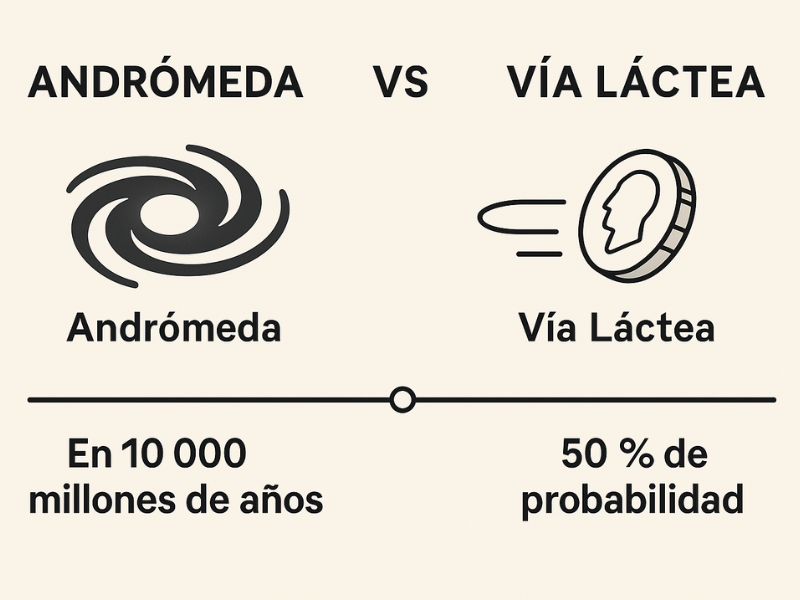
What changed recently isn’t that Andromeda stopped existing, or stopped moving, or turned out to be receding. What changed is how sure we are about the ending. A study published in Nature Astronomy in 2025 concluded there’s close to a 50% chance the Milky Way and Andromeda will not merge within the next 10 billion years, once the uncertainties and the pull of other Local Group masses get folded in properly.
The accompanying ESA Hubble note explains that with more than a decade of Hubble data plus support from Gaia, the collision is no longer treated as inevitable on a 4 to 5 billion year clock. It’s now a scenario with roughly even odds over a 10 billion year window.
That nuance is enormous. Going from a fixed destiny to a set of probabilities changes the story. It also improves it, because it lands much closer to how science actually operates: rarely a final sentence, almost always an estimate that gets sharper as new data arrives.
What they actually measured, and why the sideways part is the nightmare
Radial velocity, the part that tells you whether something is approaching or receding, comes from spectra, reading the blueshift or redshift of the light. The 2012 NASA release points out that Andromeda’s approach has been known through the Doppler effect for a long time.
The historically hard part is tangential velocity, the sideways drift across the sky. At Andromeda’s distance, that apparent shift is minuscule. You can’t watch it move in any obvious way. It gets teased out through years of observation and extraordinary instrumental precision. Back in 2012, the Hubble team presented that measurement as the decisive step for ruling out a simple flyby in the models they had at the time.
The 2025 study doesn’t say those measurements were wrong. It folds them in alongside more years of data, Gaia results, and above all a fuller treatment of the system, one where other galaxies exert realistic influence.
The supporting cast that quietly runs the show, M33 and the Large Magellanic Cloud
Thinking only about Andromeda and the Milky Way is tempting because it’s such a clean story. Two giants, one destiny. The Local Group is messier than that.
The Nature Astronomy work explains that adding the Triangulum Galaxy, M33, raises the odds of a merger in some scenarios. The surprise arrives with the Large Magellanic Cloud. Its orbit and its mass make a merger with Andromeda less likely across the system as a whole, according to the analysis.
Reuters, summarizing the result in June 2025, adds one more piece worth keeping on your radar for context. A merger between the Milky Way and the Large Magellanic Cloud is considered close to certain within about 2 billion years, well before any resolution with Andromeda.
Details like that are what rewrite the script. The universe doesn’t run like a novel with two leads. It runs like a gravitational system with a lot of actors, some of them unremarkable to the naked eye and decisive to the dynamics.
The scenarios on the table now, minus the movie drama
A merger between Andromeda and the Milky Way is still possible. Nothing has been canceled. The difference is that it stopped being the only convincing ending and became one plausible outcome among several.
The 2025 study puts the odds of no merger over the next 10 billion years at close to 50%. Reuters also reports that the probability of a collision within the next 5 billion years comes in under 2%, which dismantles the popular version where we crash for sure in 4 or 5 billion years.
In human terms, here’s what the universe is telling us. There could be a close encounter. There could be a long dance with several passes. There could be a late merger, or no merger at all inside that window. Science, with better data, is busy sharpening the odds on each one.
What would happen to the solar system if a merger did occur
Galaxy collisions aren’t rocks smashing together. They’re closer to structures blending. Stars are separated by such vast distances that a direct star-on-star hit is wildly improbable. The 2012 NASA release makes a point of saying that even in an encounter, the solar system wouldn’t be in danger of destruction just because two galaxies merged.
What could happen in a merger scenario is a change in the Sun’s orbit inside the resulting galaxy, since gravitational interactions reshuffle trajectories. Those changes play out over billions of years, and by the time that future mattered, the story of the Sun and Earth would already be governed by ordinary stellar evolution. Reuters makes the same point about timescales: we’re talking about a future so distant that it isn’t a practical concern.
Andromeda as a mirror, what it teaches us about the Milky Way
This is why Andromeda matters even if the collision angle does nothing for you. It lets us observe a big spiral much like our own from the outside. We live inside the Milky Way, which makes reconstructing its full shape genuinely hard. It’s like describing a city when all you can do is walk its streets with no way to get above it.
Andromeda gives us the opposite. Its disk, its bulge, its dust lanes, its star-forming regions, and its satellites can all be studied as one picture. When NASA released its huge Hubble mosaic in 2025, the agency emphasized both how close the galaxy is and how useful it is as a laboratory, along with the sheer scale of the project: more than a decade of work and hundreds of Hubble images stitched into a single panorama.
That outside perspective makes it easier to imagine our own galactic house. It drives home that a spiral is a dynamic system, that dust isn’t an ugly detail but raw material, that halos matter, that satellites leave marks, and that galaxies grow through encounters.
How to actually see Andromeda
Seeing the Andromeda Galaxy for the first time comes with a distinct “oh, now I get it” moment. The trick isn’t owning the best telescope on the market. It’s building conditions where light that spread out has something to stand against. When it fails, it almost always fails for the same three reasons: too much artificial light, eyes that haven’t adjusted, or a wrong expectation of how it should look. NASA is clear that Andromeda covers a huge patch of sky, several times the width of the full Moon, while its brightness is spread thin, which is what makes it subtle.
If you want a good experience with it, the priorities are a reasonably dark sky and catching it while it’s high. Altitude counts more than you’d think, because near the horizon the sky itself is brighter, the atmosphere washes out contrast, and the whole thing gets harder to find.
The kind of sky that makes it easy
The best setup is somewhere without streetlights, with an open horizon and low light pollution. You don’t have to drive across the country. Getting outside the metro area is usually enough. In most of the US, half an hour past the last strip mall gets you to a county road, a state park, or a pullout where the sky has that deep black you never see in town. A light-pollution map is worth five minutes of planning.
That blackness matters because Andromeda isn’t competing on point brightness. It’s competing on contrast. The darker your sky background, the more obvious that elongated cloud becomes.
The Moon, the elegant enemy
The Moon is gorgeous, and when it’s bright it robs you of Andromeda. A full-Moon night can wipe out galaxies entirely, even though the sky looks beautifully clear. A new Moon, or a thin crescent, changes the game. The difference shows up dramatically with binoculars, because binoculars amplify the sky background right along with everything else when there’s too much ambient light.
Dark adaptation, the thing that actually decides it
Your eyes need time. Check your phone, take a set of headlights to the face, or stand next to a porch light, and your vision snaps back to daytime mode while Andromeda disappears. The fix is simple: stay off bright screens for a while, use a dim red light if you need to see something, and give yourself twenty patient minutes. It sounds like overkill until you try it.
What you’re really going to see
To the naked eye, Andromeda shows up as a diffuse, slightly stretched smudge. No spiral arms, since those take a camera or a genuinely extraordinary sky and a well-trained eye. Through binoculars the core becomes obvious and the inner halo appears as a soft extension around it. Through a telescope the core can look bright, though a lot of Andromeda’s charm comes through at wide field, because it’s big and doesn’t always fit at high magnification.
Big but shy. That’s the whole thing in three words, and it lines up exactly with what NASA says about its apparent size.
A method for finding Andromeda that actually works
It gets much easier once you stop hunting for a star and start hunting for a small cloud. The standard jumping-off point is the Great Square of Pegasus, an easy shape to recognize in fall, which happens to be one of the best seasons for M31. From there, the chain of stars in Andromeda takes you to Mirach, and from Mirach you make the classic hop toward the spot where the galaxy shows up.
There’s something very psychological about this part. The first time is hard because you don’t know what you’re looking for. The second time you recognize it. By the third, you can’t believe you ever missed it. That shift happens because your brain learns the pattern, and once it does, it doesn’t let go.
If you want to make life easier without turning this into a class, a sky map app can confirm you’re pointed at the right region. The goal isn’t to depend on the app forever. It’s to lean on it until your eye owns the route.
Binoculars or telescope
Binoculars are usually the most rewarding way to start with Andromeda, since they pair a wide field with enough magnification to boost contrast. A standard observing pair, on a tripod if your hands aren’t steady, shows the galaxy with real presence and spares you any fuss with mounts.
A telescope brings out detail in the core, but the experience often improves when you dial magnification down and open the field up. Andromeda is one of those objects that doesn’t reward more zoom. Winning with Andromeda usually means darker sky and more patience.
Photographing Andromeda
Getting a decent photo of Andromeda is addictive, because it shows you what your eye can’t integrate. However trained it is, the human eye doesn’t stack light over minutes. A camera does, which is why the arms, the dust lanes, and the full sweep of the disk appear in images when the naked eye only gets a hint.
The key here is dropping the pressure to nail a perfect shot. Perfect shots come from very dark skies, many hours of integration, and careful processing. The motivating shot, the one that makes you grin, is a lot closer than that.
Phone and tripod, the surprising first step
A phone with night mode or pro mode can register Andromeda if the sky is dark and the phone is steady. The tripod is the difference between “something came out” and “nothing at all.” Without one, motion destroys the contrast. With one, the phone can gather light for several seconds and pull in at least the core plus a soft extension.
If your phone lets you set exposure and ISO, keep ISO moderate to avoid drowning in noise. Manual focus at infinity helps when autofocus loses its mind in the dark. The most useful move isn’t one long exposure, it’s several short frames you can stack afterward. Stacking cuts noise and coaxes structure out, even if it comes through gently.
Something great tends to happen at this point. The smudge you saw with your eyes turns into an object with real shape on the screen. The emotional jump is huge.
Camera and lens, the sweet spot
A camera with a lens somewhere between 50mm and 135mm is a comfortable combination for M31. It fits the galaxy in with some context while still rendering it large enough to read as a galaxy rather than a dot. On a tripod, you can shoot many short exposures to avoid star trailing, with the maximum length depending on your focal length and whichever rule of thumb you use to estimate it.
The trick, again, is accumulating signal. Many short frames stacked add up to one long integration, and long integration is what brings out detail. This approach has a real advantage: no equatorial mount required to get going. The cost is time and patience, which tends to be more accessible than a big equipment upgrade.
Tracking mounts, when you want to level up
A tracking mount changes what kind of photography you’re doing, because it lets you run longer exposures without smearing the stars. That raises signal per frame and makes it far easier to capture the outer disk and the dust lanes cleanly. It also brings finer adjustments and more demanding processing, along with serious satisfaction the first time real spiral structure shows up.
At this level you’re not taking a photo anymore, you’re building an image. The final result is many layers of information stacked together, and it shows.
Processing, where the magic surfaces
Processing isn’t makeup, it’s signal recovery. The camera captured information that’s genuinely there, just buried in noise. Stacking, calibrating, and adjusting levels brings out what the sensor actually recorded. The goal isn’t turning Andromeda into a poster. It’s keeping a natural look, with reasonable color and intact texture.
Take your time with it. A gentle edit almost always beats an aggressive one. Andromeda has a natural elegance, a bright core with a disk that fades out delicately, and pushing contrast too hard breaks that feeling.
Andromeda facts that change how you look at it
Some numbers get repeated a lot and delivered without context. With Andromeda that happens to three of them: distance, apparent size, and approach speed.
The distance sits around 2.5 million light-years, which means you’re seeing it as it was 2.5 million years ago. That figure keeps coming up because it’s the most direct way to understand that astronomical observation is always observation of the past.
The apparent size, which NASA describes as several times the width of the full Moon, explains why Andromeda isn’t a little ball. It’s large. Its light is just gentle.
The approach speed, usually quoted around 110 kilometers per second or the equivalent depending on the reference frame, sounds gigantic because it is. It still doesn’t change the fact that distance runs this show. That contrast between “fast” and “unbelievably far” is a reminder of how quickly our intuition falls apart once we leave human scale.
Frequently asked questions about the Andromeda Galaxy
Can you see Andromeda from a major city?
You can, but it’s rarely worth grinding away at without changing something about the setup. In a big city the problem isn’t a lack of observing power, it’s an excess of background light. Andromeda has low surface brightness because its light is spread across an enormous area, and light pollution eats exactly that kind of object. If you live downtown, the realistic move is finding a dark spot on the outskirts or taking a short drive somewhere with a blacker sky, even if you already own binoculars or a telescope. The moment the sky background drops a little, the galaxy comes through far more clearly.
What is the best time of year to see Andromeda?
Fall and early winter are the most rewarding, because Andromeda’s region of sky climbs to a good altitude at reasonable hours. Altitude matters because it cuts down the atmospheric wash and improves contrast. The exact timing depends on the month and what hour you head out, but the general recipe works well: fall nights, dark sky, minimal moonlight. That combination is what turns Andromeda from a suspicion into a clear observation.
Does it look like a galaxy to the naked eye?
To the naked eye it looks like a diffuse, elongated smudge, not a defined spiral. The difference from photographs comes down to the fact that your eye doesn’t accumulate light over seconds or minutes the way a camera does. That’s why images show arms, dust lanes, and the full extent of the disk while your eye picks up something much softer. NASA also stresses Andromeda’s huge apparent size in the sky, several times the width of the Moon, but that light is spread so thin that contrast is what decides the outcome.
What is the minimum I need to see it well?
The minimum isn’t a telescope, it’s a dark sky and a few minutes of dark adaptation. The first big upgrade is a pair of binoculars, because they gather more light and make the core and the nearby extension much easier to separate out. A telescope can help, but Andromeda is so large that high magnification pushes part of the galaxy out of the field and you lose the sense of the whole. Wide field is usually the prettier view.
Why does my app say Andromeda is right there when I can’t see anything?
Usually one of two reasons. The first is that you’re looking at the right place, but the sky background is too bright and the galaxy is washing out. The second is that your eyes haven’t adapted to the dark yet, or you checked a bright screen recently. The practical fix is straightforward: find a corner with no direct lights, wait a while, and try looking slightly to one side of the exact spot, using averted vision. That technique works because the eye detects faint things better away from the center of your gaze.
What does it mean that Andromeda is 2.5 million light-years away?
It means the light reaching you left there roughly 2.5 million years ago. Looking at Andromeda is looking at the past. The figure gets repeated so often because it completely reframes what you’re seeing: not a snapshot of now, but an old message still traveling through space.
Is the collision with the Milky Way off the table?
It isn’t off the table, but it’s no longer considered inevitable with the confidence that got publicized years ago. In 2012, NASA announced that the Milky Way and Andromeda appeared headed for a collision with high confidence, based on Hubble measurements of Andromeda’s motion.
In 2025, a Nature Astronomy study drawing on more than a decade of Hubble data plus Gaia concluded that the probability of no merger within the next 10 billion years could be around 50%. ESA Hubble circulated the same revision, emphasizing that the outcome is no longer sold as inevitable but as a range of scenarios with probabilities attached.
What role does the Large Magellanic Cloud play in all this?
The Large Magellanic Cloud is a massive satellite of the Milky Way and its gravitational influence is not negligible. The 2025 analysis indicates that including its mass and its dynamics can make a merger between the Milky Way and Andromeda less likely on the timescale of the classic headline. Put plainly, this isn’t a duel between two giants. It’s a system with more important players than the story usually admits.
Could any of this affect us?
Not in any practical sense. Even if a merger happened, a direct collision between stars is extremely improbable given the vast distances separating them. The 2012 NASA release makes the point that while the interaction could reshuffle orbits, the solar system doesn’t get destroyed simply because two galaxies blend together.
Andromeda from wherever you happen to observe
If you’re observing from a city
In the city, take one thing on board kindly: not seeing it isn’t a skill problem. Andromeda is a low-contrast object, and an urban sky background works against you. What tends to help is minimizing direct lights, finding the darkest corner available to you, going out on moonless nights, and using binoculars. Waiting until Andromeda is high up helps too, since the closer to the zenith, the less atmosphere it has to shine through and the more contrast you claw back. If it’s still a fight, one short trip to a better sky usually gives you a much clearer first look, and that makes it far easier to hunt down later from worse skies.
If you’re observing from the coast
Coastal skies come in two flavors: excellent and treacherous. The usual culprit is humidity, which scatters artificial light and lifts the sky glow, and which will also fog your optics and ruin photos. On clean nights the coast can hand you gorgeous skies, but it pays to pick a stretch with dry air and to stay away from direct streetlight. If you’re shooting, a simple dew shield or careful dew management can be the difference between a full session and packing up early.
If you’re observing from the plains or the interior
Inland you often get a real advantage: drier nights and transparency that can be a gift. That doesn’t erase the light pollution from nearby towns, but once you’re out in genuinely rural country, an interior sky can be superb. Here the trick is usually picking a night with little Moon and giving yourself a few minutes to dark-adapt. Under a dark inland sky, Andromeda tends to show up easily with the naked eye and with real presence in binoculars.
If you’re observing from the mountains
Mountains score high on darkness and transparency, though not always on comfort. Cold and wind will cut your session short, so dress for more than you think you need. When the sky is clean, the mountains give you beautiful contrast and Andromeda becomes far more obvious, with a standout core and a longer visible extension. Pull out binoculars up there and that’s usually the moment people fall for deep-sky observing for real.
Common mistakes when hunting for Andromeda, and how to dodge them
The most frequent one is looking for brightness where the object is subtle. Andromeda doesn’t read as a bright star, so if your eyes are hopping star to star waiting for a flash, you’ll skip right past it. It works far better to search for a soft elongated cloud and let averted vision catch it.
Another classic is observing without giving your eyes time to adapt. Glance at your phone and your sensitivity drops, taking the faint stuff with it. Once you get a handle on this, a lot of observations improve without changing your gear or your location.
Overdoing magnification is common too. Andromeda is big, and the prettiest result often comes from backing off and gaining field. More magnification doesn’t always mean seeing more. Sometimes it means seeing less of the whole.
Sources and references
Andromeda’s distance and the collision scenario as it was publicized in 2012 come from NASA’s release on the future encounter between the two galaxies.
The apparent size and the Hubble mosaic project, both of which help explain why the galaxy is large but softly lit, are covered in NASA materials tied to observations of M31.
The 2025 revision, with its conclusion that a merger is no longer inevitable and that the odds of no merger within 10 billion years may sit near 50%, rests on a study published in Nature Astronomy and the associated ESA Hubble communication, along with press coverage summarizing the reported probabilities.
Andromeda has a lovely way of staying with you. Not because it looks spectacular to the naked eye, but because it forces you to change how you look. Once you find it, even as a faint smudge, the sky stops being a ceiling with stars stuck to it and becomes a place with real depth, real neighbors, and stories that are still unfolding.
If you feel like it, tell me in the comments what part of the country you observe from, whether you’re doing it from a city or somewhere darker, and whether you’ve ever tried to track this one down. Mention whether you have binoculars, a camera, or a telescope and I can point you toward a specific plan for your situation, without making it complicated.