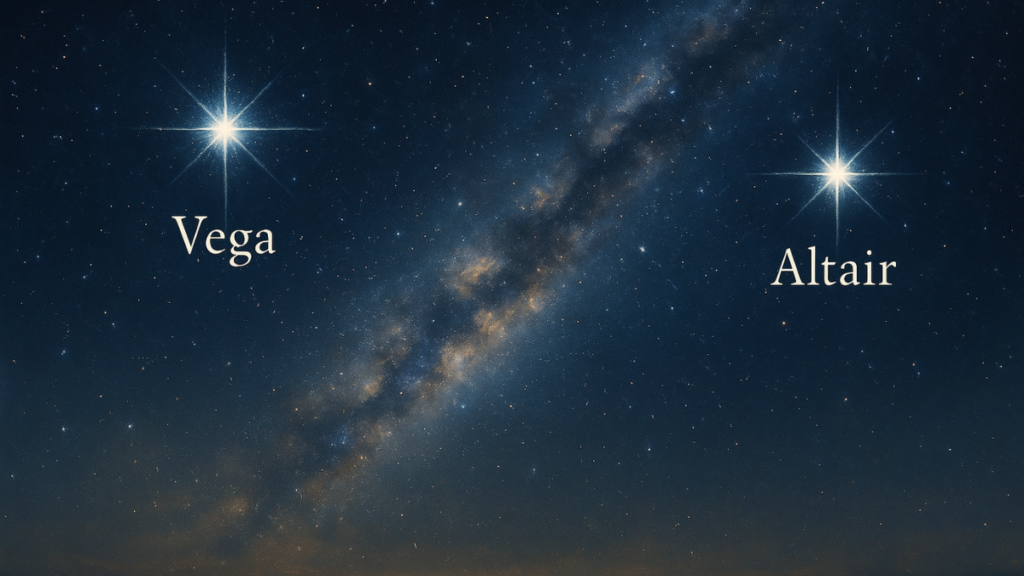
The legend of Vega and Altair, the story that runs straight across the Milky Way, and where it meets real science, the summer sky, and our own history. A close look at two stars that will change the way you see the night.
Vega and Altair, an intimate conversation under a starry sky
There are nights when you look up and the sky seems to be talking to you. I don’t know whether that happens to you too. It happens to me constantly, especially in summer, when the Milky Way turns up as a pale smear running through the dark. On nights like that, when everything goes quiet and the air stays warm, two stars always pull my eye: Vega and Altair.
For years I looked right past them. I knew they were up there. I knew they were bright. I knew they belonged to the Summer Triangle, and that was the whole of it. Then I found the legend that ties them together, and I’ve never seen them the same way since.
Vega and Altair aren’t two dots of light. They’re the leads in one of the oldest, most beautiful love stories anyone has ever told, handed down for generations, borrowed by festivals and songs and poems and wishes. It comes alive again every time somebody looks up and finds those two stars sitting on opposite banks of the bright river of the Milky Way.
Ever since I learned it, a clear night feels like walking in on a cosmic play that’s been running for thousands of years. A story with no final act, because in some way it’s about us.

What Vega and Altair actually are
Before the myth, I want you to see them as they really are, because the story is lovely, but knowing where these stars sit and what they’re doing gives the whole thing more weight.
Vega and Altair are two of the brightest stars in the northern sky. Together with Deneb they form the Summer Triangle, a kind of annual signal that warm nights and clear skies have arrived.
Vega belongs to Lyra, the Lyre.
Altair belongs to Aquila, the Eagle.
Stretching between the two of them is the Milky Way, a wide current of light.
Vega, the blue star that lights up Lyra
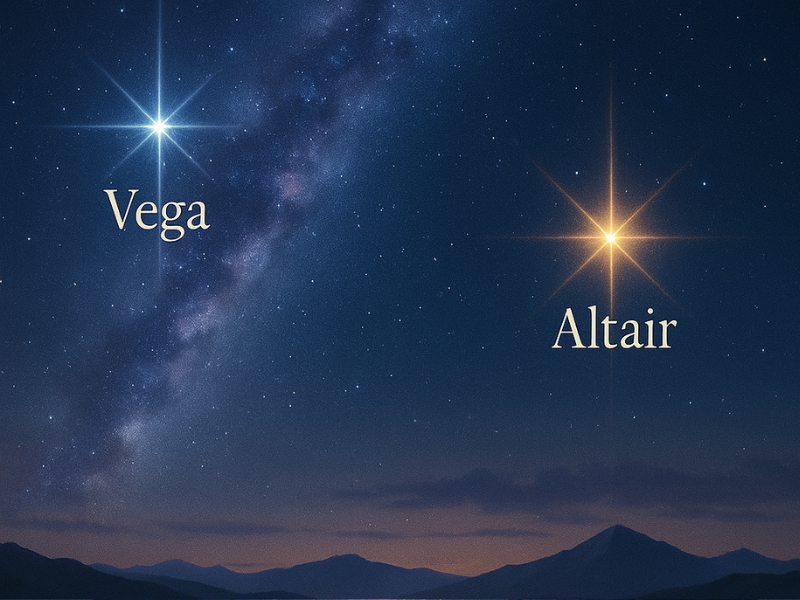
Step outside on a clear summer night and Vega is usually the brightest thing straight overhead. Its light is clean, almost electric, a blue-white that separates it from everything nearby. It sits about 25 light-years out, which in cosmic terms is next door.
Vega is younger than the Sun and a good deal brighter. It’s one of those stars with enough presence that your eye keeps going back to it. Plenty of cultures treated it as a major player, so it makes sense that the legend cast it as Orihime, the weaver princess.
Altair, the heart of the Eagle
Altair runs a little dimmer than Vega and it’s every bit as interesting. It’s closer, only 17 light-years away. Its light is a soft, warm white, and it comes with one strange feature: it spins so fast that it’s visibly squashed at the poles. A restless star, never quite still, which fits the herdsman Hikoboshi perfectly.
It carries a different energy than Vega. If Vega is a sharp, decisive flash, Altair is the gentler glow. Just as lovely, quieter about it.
The legend of Vega and Altair, the princess and the herdsman split by the Milky Way
Here’s where it gets good. The best-known story about Vega and Altair comes out of China and Japan, and it’s celebrated at Tanabata, a festival built around love, reunion, and wishes. What follows is a blend of the versions that get told most often.
Orihime, the weaver princess
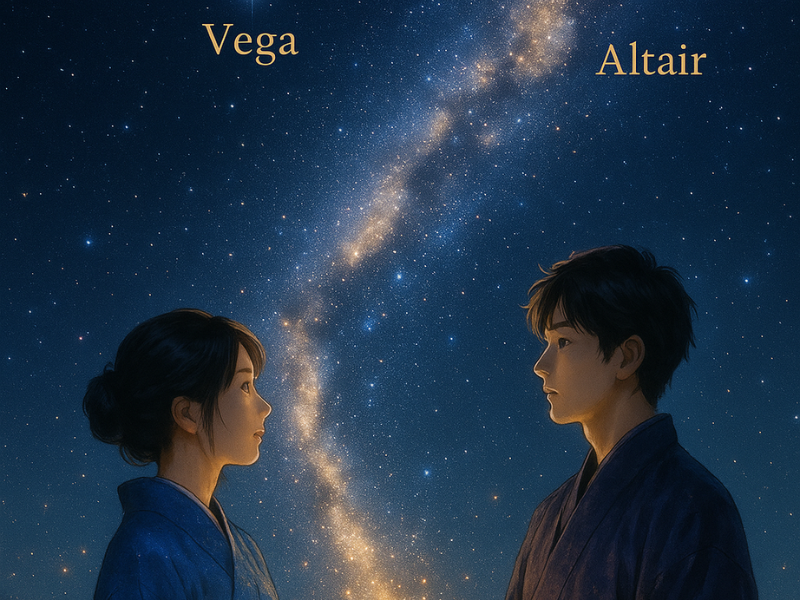
The story goes that Orihime lived in the sky, a princess who wove astonishing cloth for the gods. Her loom turned out colored clouds, soft light, delicate breezes. She was so devoted to the work that she had time for almost nothing else. Her father, the Sky King, loved her deeply, and it worried him to see her always alone, always buried in the weaving.
Orihime is Vega.
Hikoboshi, the herdsman of the stars
On the far bank of the celestial river lived Hikoboshi, a young herdsman who looked after the cattle of the gods. He worked among lights, constellations, and long stretches of silence. He was disciplined, warm, and unusually good with the animals in his care.
Hikoboshi is Altair.
A love that throws the sky off balance
When the Sky King introduced them, the inevitable happened. They fell for each other on the spot. An intense, guileless, wide-open love, two stars that were always going to find each other. They spent so much time together that the work stopped. Orihime’s loom went quiet. Hikoboshi’s cattle wandered loose. Order started slipping out of the heavens.
The separation, a river of stars
Furious at the mess, the king made a hard call. He pulled the lovers apart and set the Milky Way between them, a river of light with no crossing. Orihime cried so hard that her grief got through even to her father, so he allowed them one thing: they could meet once a year, on the seventh day of the seventh month, if they could find a way over the water.
On that night, thousands of magpies fly up and lock their wings into a bridge so Orihime can walk across to Hikoboshi. If it rains, the magpies can’t fly, and the reunion waits another year.
Ever since, July 7 has been Tanabata, the festival of wishes. People write what they’re hoping for on strips of colored paper and hang them from bamboo branches, handing their wishes over to the stars.
How to find Vega and Altair in the sky
One of my favorite things about this story is that you don’t need any imagination to see the cast. They’re right up there, shining like they’d tell you the whole thing themselves if they could.
How to spot them
Head out on a July or August night with a clear sky, tip your head back, and look for the brightest point more or less straight above you. That’s almost certainly Vega. Now drop your eyes toward the east and you’ll pick up another standout: Altair.
Between them runs the pale band of the Milky Way, a road of stars that looks like it was set there on purpose to keep the two lights apart.
What it feels like once you know the story
Knowing the legend changes the sky. I promise it doesn’t look the same afterward. Vega and Altair stop being points and turn into characters. Seeing them on opposite sides of that glowing river brings on something hard to name, somewhere between homesickness, affection, and an odd flicker of recognition. For a second the sky is letting you in on something old.
The Milky Way, the perfect stage for this story
The Milky Way isn’t the backdrop here. It’s the reason the story exists at all. Our galaxy, seen from where we happen to be standing, creates a perfect illusion: two lovers split by a river of light.
The Milky Way seen from inside
The Milky Way is a spiral galaxy holding a few hundred billion stars. We’re inside it, out on the Orion Arm, so that pale band crossing the sky is the galaxy’s own disk viewed edge-on from a seat within it.
Which means the celestial river in the legend is the actual structure of our galaxy. Myth and science land on the same image without stepping on each other.
Why the myth works so well
Vega sits on one side of the Milky Way. Altair sits on the other. The sky looks staged. The story practically writes itself.
What this story is good for in real life
Beyond being beautiful, the legend carries a few things worth keeping.
Love finds its own timing
Two lovers who get one night a year is a reminder that some kinds of love ask for patience. Things don’t arrive when we want them. They arrive when they arrive.
Distance doesn’t undo a strong bond
The Milky Way stands between them and both stars keep burning anyway. The story continues. The connection holds.
Beauty is in the sky, and also in the looking
The same star can be a dot or a character. It depends on what you know, what you’re feeling, and how you look at it.
We’re less cut off from the universe than we think
This story exists because somebody looked up and got moved by it. Reading it and looking up yourself puts you in the same chain.
The science behind the myth, what makes Vega and Altair special
The legend is gorgeous. The reality of these stars is arguably better.
Vega up close
Young, hotter, and far brighter than the Sun. It spins quickly, though nothing like Altair does. There’s a disk of dust circling it that may be busy building planets, and thanks to the slow wobble of Earth’s axis, Vega takes over as our North Star in roughly 12,000 years.
Altair up close
One of the closest bright stars to the solar system, spinning fast enough that it’s flattened into an oval rather than a sphere. It sits in one of the oldest constellations on the map, and its brightness flickers by a hair because the star pulsates.
What they have in common
Both are easy to find, both line up with the Milky Way from our vantage point, and both have been carrying stories for thousands of years.
How to bring Tanabata and the story of Vega and Altair into your own life
You don’t have to live in Japan to feel what this legend is doing.
Write your wishes down
Use a strip of colored paper, the way it’s done at Tanabata. Write slowly, from wherever it’s coming from, no rush about it. Then tuck it in a drawer or hang it from a houseplant.
Go look at the summer sky
Make a small ritual out of it. Find Vega and Altair, run the story back through your head, and let it remind you that some things outlast us by a very long way.
Give yourself a quiet minute
Five minutes under an open sky is usually enough to feel like yourself again.
Frequently asked questions about Vega and Altair
What does the legend of Vega and Altair symbolize?
Love, patience, distance, and the hope of meeting again.
What does it have to do with the Milky Way?
The Milky Way is the celestial river that keeps the two lovers apart.
Are they easy to see in summer?
Yes, especially from somewhere with little light pollution.
What is Tanabata?
A Japanese festival celebrating the once-a-year reunion of Vega and Altair.
Are they close to Earth?
Relatively, yes. Vega is about 25 light-years away and Altair about 17.
You, the sky, and the endless story of Vega and Altair
The story of Vega and Altair is one of those that makes the sky come alive. It isn’t only a pretty myth, and it isn’t only an astronomy lesson. It’s a bridge between what we know and what we feel, between science and magic, between back then and right now.
Next time you’re out on a summer night, find that band of light crossing overhead. Look for Vega on one bank and Altair on the other, and remember you’re watching a story people have been telling for thousands of years. A story that has moved people in every culture it reached. A story that stays alive because it starts over every time somebody looks up.
Had you heard this legend before? Want more stories from the sky? What did Vega and Altair leave you with? I’ll be in the comments.