An intimate, warm, unhurried journey through the Milky Way. Find out how our galaxy was born, what it looks like inside, where Earth sits within it, and why understanding it can change the way you look at the sky and at your own life.
The Milky Way, an intimate conversation about our home in the universe
There are nights when I stop, just like that, and look up. Something curious happens to me. For a moment I quit thinking about the day, the worries, the to-do list. Then it hits me that I’m inside something far bigger than I’m able to picture, and that something is called the Milky Way.
It’s a discovery we make a thousand times and forget just as often. We know we live in a galaxy, we’ve repeated it without thinking since grade school, but we rarely stop to actually feel it. When we do, I promise you something shifts inside, as if the universe put a hand on your shoulder and said: take it easy, there’s room for everything here, even for the things you don’t understand yet.
The Milky Way isn’t just a spiral galaxy with a name we memorized in school. It’s the stage where our entire story takes place. Where the Sun was born, where Earth formed, where life appeared, where you and I showed up. It’s our cosmic home, and it’s also our origin and our destination.
What the Milky Way actually is
The truth is that the Milky Way is like a giant city, except that instead of streets full of cars and buildings full of people, it’s made of gas clouds, dust, star clusters, and hundreds of billions of stars. I’m not exaggerating: hundreds of billions. It’s overwhelming even to say out loud.
It’s a barred spiral galaxy, which means it has an elongated core with luminous arms sweeping outward from it. Those arms are like endless avenues where new stars are being born all the time.
Picture the scene from the outside for a second. A spiral of light unfurling in the dark. A soft, pulsing glow around a dense golden core. Then there’s you, on a small blue rock, orbiting an average star that barely stands out next to the others. Your house, your history, your whole life, all of it inside a speck that would disappear in a photograph.
Even so, there you are. That’s what makes the Milky Way a reminder of something precious: we’re small, yes, but we’re part of something beautiful.
The story of the Milky Way, how our stellar home was born
The history of the Milky Way is so long that it’s hard to take in. To understand it we have to travel back almost to the birth of the universe, when there were no galaxies, no stars, and no planets, only an immense cloud of hydrogen and helium drifting in the void.
The beginning, a cloud that starts to shine
About 13.8 billion years ago, the universe began to cool after the Big Bang. Matter was spread out almost evenly, though not quite. Some regions were a little denser than others, and in those regions gravity got to work, pulling atoms closer together into more compact clouds.
One of those clouds gave rise to what is now the Milky Way. At first it had no shape, just a denser patch where the first stars began to form. They were enormous, extremely hot stars. They lived very short lives, but they died in explosions so intense that they flooded their surroundings with new elements.
Those elements, scattered by the first supernovae, became the raw material for everything we know today. The calcium in your bones, the iron in your blood, the oxygen you breathe, all of it exists thanks to the earliest generations of stars in the Milky Way.
Growing up through encounters and mergers
The Milky Way didn’t grow alone. Over billions of years it ran into smaller galaxies and absorbed them, little by little. Those mergers reshaped its structure, adding to its size and its brightness.
When astronomers study the halo surrounding the galaxy, they find the leftovers of those mergers. They’re like scars from ancient collisions, streams of stars caught in strange orbits, luminous keepsakes from other galactic worlds that are now part of ours.
The coming encounter with Andromeda
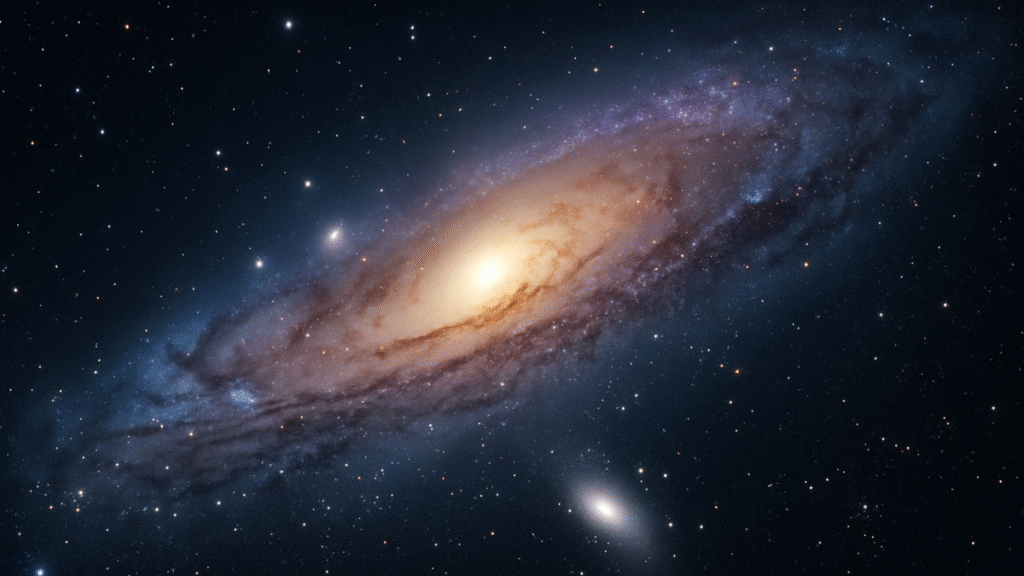
In roughly 4.5 billion years, the Milky Way will live through one of the most spectacular events in its history. It will meet the Andromeda Galaxy head-on. They won’t crash like two cars, of course, since stars sit so far apart that most of them will never touch anything. The shape of both galaxies, though, will change completely. Their arms will warp, their stars will redistribute, and their cores will merge.
It will be a slow, gorgeous, unhurried dance lasting millions of years, and a new galaxy will come out of it. There’s something almost poetic about knowing our own galaxy has a future like that.

What the Milky Way looks like from the inside
However hard we try, it’s difficult to picture the Milky Way from within. It’s like trying to see the shape of your house while you’re shut inside a windowless room with no way out. Thanks to modern astronomy, though, we can reconstruct its structure and get a fairly faithful sense of it.
The galactic core
The center of the galaxy is an intense place. It’s packed with old stars, tightly bound clusters, and a tremendous amount of radiation. That’s where Sagittarius A* sits, a supermassive black hole with about four million times the mass of the Sun.
Despite everything the words black hole suggest, it isn’t a devouring monster or a threat to the Milky Way. It’s a stable, natural part of the system. The galaxy turns around it like a dark heart keeping time for everything else.
The galactic disk
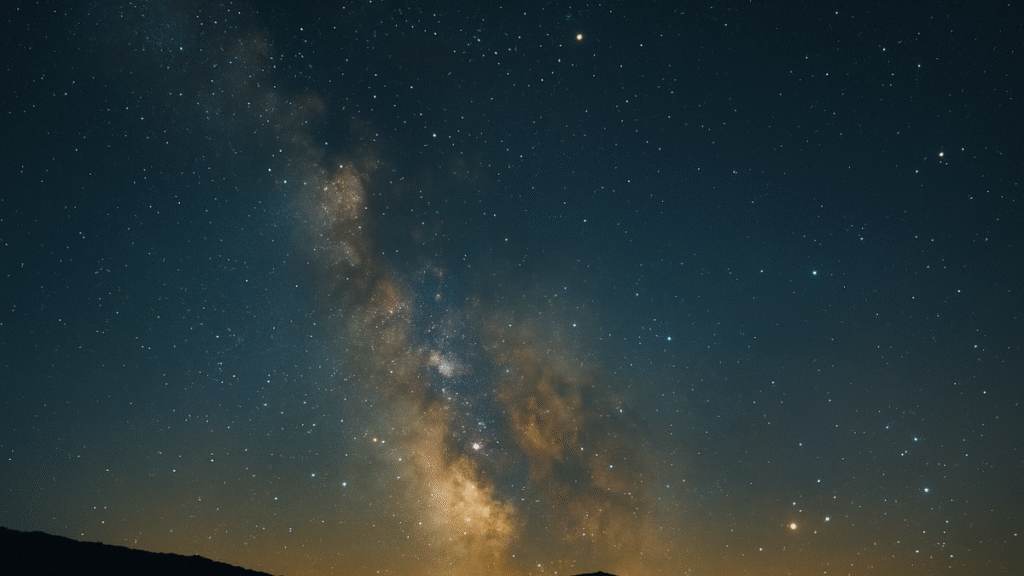
The disk is like an immense sheet holding most of the galaxy’s stars. It’s the part of the Milky Way we see when we look up on a night with no light pollution. That pale band crossing the sky is the galactic disk viewed from inside it.
It measures about 100,000 light-years across. The Sun and Earth sit inside this disk, in a relatively quiet stretch of it.
The spiral arms
The spiral arms are regions where gas and dust pile up, and that’s where new stars are constantly being born. Think of them as cosmic gardens of fresh light. The Sun sits in a small secondary arm called the Orion Arm, a stable, fairly peaceful area compared with the central bulge.
The galactic halo and dark matter
The halo wraps around the whole galaxy like an immense sphere. It’s made up of very old stars and globular clusters, but its biggest component is invisible: dark matter.
Without dark matter, the Milky Way couldn’t hold its structure together. It works like invisible scaffolding, a gravitational skeleton that supports the entire shape.
Where exactly we are inside the Milky Way
Every time I think about this, I get a mix of curiosity and tenderness. Earth sits about 27,000 light-years from the center of the Milky Way. If the Sun were a house, Earth would be in a quiet, pleasant neighborhood. Not too close to the noise downtown, where stellar activity is so intense that the radiation would be lethal, and not so far out on the edges that there’s no material left to build new worlds.
Our solar system makes one full lap around the galactic center every 230 million years, which means we’ve completed exactly one lap since the dinosaurs appeared. There’s something lovely about the whole of human history taking up barely a single step in the solar system’s cosmic dance.
Where the name “Milky Way” comes from
Before we knew anything about galaxies, our ancestors looked up and saw a river of light, a pale band crossing the night like a road. That image was powerful enough to inspire myths and legends in every civilization.
Milky Way literally means road of milk. The Greeks believed it was milk spilled by the goddess Hera. The Romans took the name and used it as it was. For many Indigenous peoples it was a path connecting the world of the living with the world of the spirits.
I love thinking that even without telescopes or modern science, so many cultures grasped in their own way the symbolic weight of that river of light. They sensed something special was up there.
The Milky Way in numbers that stop you cold
Some figures look cold on paper, but they put your feet back on the ground or, more accurately, out in the cosmos.
Approximate diameter: 100,000 light-years
Thickness: 1,000 light-years
Number of stars: between 100 billion and 400 billion
Age: roughly 13.6 billion years
The Sun’s orbital speed: 220 km per second, about 137 miles per second
Estimated number of planets: more than 100 billion
Estimated number of potentially habitable worlds: tens of billions
Every time I read numbers like these I’m left speechless. Sometimes I think we’re just not built to understand figures like that, because the Milky Way is immense in the most literal sense of the word.
Earth, our home inside the home
Of everything in the Milky Way, there’s one special little dot, a blue sphere tucked into a spiral arm. A sphere that, through an almost miraculous combination of circumstances, was able to hold life.
Earth sits at exactly the right distance from the Sun to have liquid water. It has a stable atmosphere, a magnetic field that shields us from radiation, a large Moon that steadies the tilt of our axis, and active geology that recycles nutrients. It’s an almost magical balance.
We live inside that balance. Sometimes, when everyday life feels like too much, I think about how many coincidences had to line up for us to exist at all. It brings me a little peace.
Earth isn’t just our planet. It’s an oasis in the endless desert of the Milky Way.
Dark matter, the quiet secret of our galaxy
Dark matter is one of the great mysteries of modern science. We know it’s there, but we don’t know exactly what it is. It gives off no light and no energy, you can’t see it, yet it pulls with gravity. Without it, the Milky Way couldn’t hold on to its outer stars at the speeds we measure them moving.
It’s as if most of the galaxy were made of something invisible, something we don’t understand that props up everything else. It reminds me of the things in life we can’t explain but that quietly keep it all in balance.
The stars of the Milky Way
The Milky Way holds stars of every color, size, and age. There are young blue stars burning through their fuel with ferocious intensity. There are yellow stars like the Sun, balanced and relatively calm. There are red giants nearing the end of their lives. There are white dwarfs too, the remains of stars that already died.
Stars live in cycles. They’re born from gas and dust, they grow, they shine for millions of years, and when the end comes, they hand their material back to space. It’s an endless cycle that keeps the galaxy alive.
The loveliest part is that we’re literally made of that recycled material. The iron in your blood formed inside a star that died before the Sun existed. We breathe air made of atoms that passed through ancient stars.
We’re the Milky Way in human form, and in some way the galaxy is looking out through our own eyes.
Star clouds, nebulae, and the places where light is born
There are places inside the galaxy that look like something out of a dream. Nebulae are immense clouds of gas and dust lit up by nearby stars, and some are so large you could fit several solar systems inside them.
New stars are born in nebulae. It’s like watching the universe give birth. Every small bright point taking shape inside those clouds will be a star that lives for millions of years.
Some nebulae glow pink, others green or blue. Some are the remains of stars that exploded, others are stellar nurseries. They’re cosmic landscapes that remind us the Milky Way is alive, that it isn’t a static structure but an organism that breathes and changes.
The future of the Milky Way
The future of the Milky Way is one of motion, change, and beauty. Billions of years from now, once the Sun has aged and the galaxy has shifted its appearance, the Milky Way will begin its final dance with Andromeda. The two will merge slowly, in a transformation that’s gentle but colossal. Their arms will mingle, their cores will drift together, and a new, larger galaxy will emerge.
It’s a story none of us will see, yet it’s part of our cosmic destiny. Knowing it somehow connects us to a future that reaches far beyond any human life.
Frequently asked questions about the Milky Way
What is the Milky Way?
The Milky Way is the galaxy we live in, a barred spiral holding hundreds of billions of stars.
How many stars does it have?
Somewhere between 100 billion and 400 billion, by current estimates.
What is at the center of the galaxy?
A supermassive black hole called Sagittarius A*.
Where is Earth inside the Milky Way?
In the Orion Arm, about 27,000 light-years from the galactic center.
Will the Milky Way collide with another galaxy?
Yes, with Andromeda in roughly 4.5 billion years.
Can you see the Milky Way from Earth?
Yes, but only from places without light pollution and on clear nights.
Looking at the Milky Way changes something inside us
Sometimes I think the Milky Way is a constant reminder that we’re part of something immense, that we’re connected to the universe far more deeply than we tend to believe.
When I look up and see that band of light crossing the sky, I feel like I’m looking at my own origin. I’m looking at the place that made the atoms in my body. I’m looking at a story that started long before us and will keep going long after.
I always wonder what you feel when you look at the Milky Way. Whether it brings you peace, whether it stirs up questions, whether it gives you that mix of vertigo and tenderness I get.
You, me, and the Milky Way
The Milky Way isn’t just a galaxy. It’s our home, our origin, and our mystery. It’s the stage where life unfolds and where the stories of the universe get written. We’re here inside it, looking out like two travelers trying to make sense of the map they’re standing on.
Every time you look up, remember that you’re not watching something separate from you. You’re seeing your house from the inside, seeing light that traveled hundreds or thousands of years to find you.
Now I want to hear from you. What do you feel when you think about the Milky Way? Does it inspire you, intrigue you, calm you down, make your head spin?
I’ll be reading in the comments.